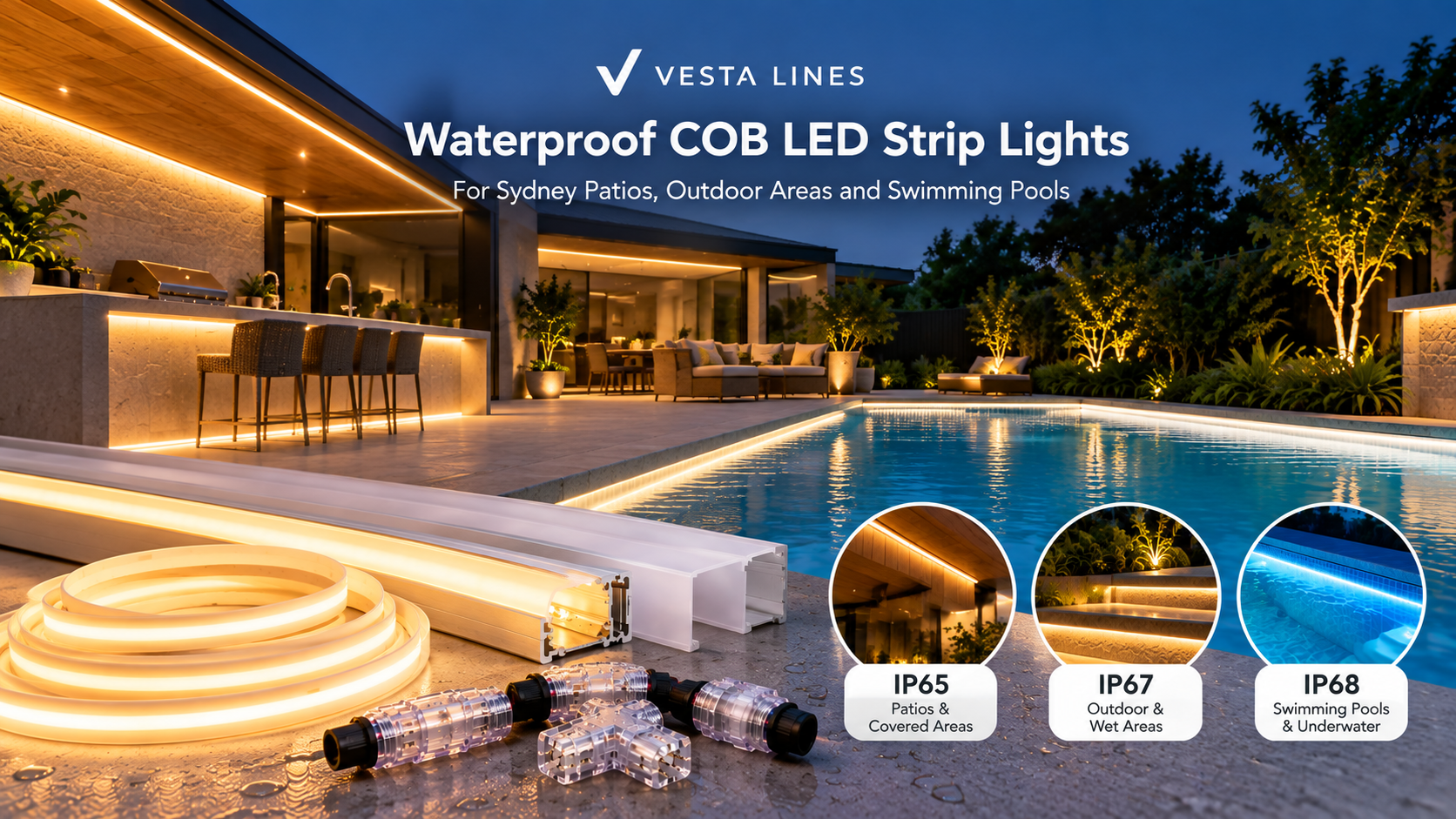
Best Water-Resistant Waterproof LED Strip Lights for Sydney Patios
Sydney’s outdoor lifestyle makes patios, balconies, alfresco areas and outdoor entertaining spaces an important part of many homes. The right lighting can transform these areas after sunset, and water-resistant LED strip lights are an excellent option for creating discreet, modern illumination.
Unlike traditional outdoor fittings, LED strip lighting can be integrated beneath benches, around outdoor kitchens, inside architectural profiles, along steps or around covered patio areas to produce a clean and continuous lighting effect.
However, outdoor LED strip lighting needs to be selected carefully. Exposure to moisture, rain, humidity and changing temperatures means the strip, connectors, power supply and installation method all need to suit the environment.
This guide explains how to choose the best water-resistant LED strip lights for Sydney patios and outdoor areas.

Why Use LED Strip Lights for Sydney Patios?
LED strip lighting works particularly well in outdoor entertaining spaces because it can provide illumination without large or visually intrusive fittings.
It can be used for both practical lighting and architectural effects.
Popular patio applications include:
- Under outdoor kitchen benches
- Beneath cabinets and shelving
- Along patio ceilings
- Around pergolas
- Under handrails
- Along steps
- Around seating areas
- Inside architectural features
- Around planter boxes
- Along pathways
- Under bar counters
- Around outdoor entertainment areas
For a sophisticated result, LED strips can also be installed inside aluminium LED profiles with diffusers, helping create a clean, finished appearance.
What Does “Water Resistant” Mean for LED Strip Lights?
When choosing LED strip lighting for outdoor use, one of the most important specifications to understand is the IP rating.
IP stands for Ingress Protection.
An IP rating indicates the level of protection an enclosure provides against solid objects and water.
You may commonly see LED lighting products described with ratings such as:
| IP Rating | Typical Application |
|---|---|
| IP20 | Dry indoor locations |
| IP44 | Limited protection against splashing water |
| IP65 | Water-resistant applications and protected outdoor areas |
| IP67 | Higher protection against water exposure and temporary immersion under specified test conditions |
| IP68 | Products specifically designed and rated for continuous immersion under manufacturer-defined conditions |
The appropriate rating depends on where and how the LED strip will be installed.
An LED strip beneath a well-covered patio roof may face very different conditions from a strip installed close to a pool, garden edge or exposed external wall.
IP65 vs IP67 LED Strip Lights
For outdoor installations, IP65 and IP67 LED strip lights are two common options.
IP65 LED Strip Lights
IP65-rated products are protected against dust ingress and water jets under the conditions defined by the rating.
They may be suitable for applications such as:
- Covered patios
- Alfresco areas
- Under outdoor cabinetry
- Protected pergolas
- Covered balconies
- Other locations where the strip isn’t expected to be submerged
The exact suitability still depends on the product and installation conditions.
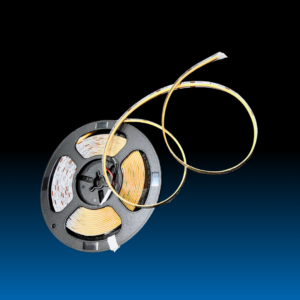
IP67 LED Strip Lights
IP67 provides a higher level of water protection.
IP67-rated products are tested for temporary immersion under defined conditions, making them useful where the installation may experience greater exposure to water.
Possible applications include:
- More exposed patio installations
- Outdoor architectural features
- Areas subject to rain or wash-down
- Landscape lighting applications
- Outdoor cabinetry
- Other exposed locations where the product’s specifications permit
Importantly, an IP67 LED strip does not automatically make the entire lighting installation IP67.
Connectors, cable entries, joins and terminations also need appropriate protection.
Don’t Forget the LED Strip Connections
This is one of the most important considerations when designing outdoor LED strip lighting.
You might purchase a water-resistant LED strip, but if the strip is connected using an unsuitable indoor connector, the connection can become a vulnerable point in the installation.
For outdoor projects, consider the complete system:
LED strip + connectors + cable + profiles + driver + controller + terminations
Vesta Lines offers IP67 waterproof LED strip connector options for compatible strip-light installations, allowing installers to create cleaner connections while maintaining an appropriate level of protection when installed according to the product requirements.
Choose the Right Colour Temperature for Your Patio
Water resistance isn’t the only consideration.
Colour temperature has a major influence on the atmosphere of an outdoor entertaining area.
2700K – Warm White
2700K produces a warm, inviting appearance.
It can work particularly well around:
- Timber finishes
- Outdoor dining tables
- Lounges
- Restaurants
- Hospitality areas
- Decorative landscaping
3000K – Warm White
3000K remains warm while providing a slightly cleaner appearance.
For many residential patios and alfresco areas, 3000K is an excellent balance between atmosphere and practical illumination.
4000K – Neutral White
4000K produces a brighter, more neutral appearance.
It can be useful around:
- Outdoor kitchens
- Preparation benches
- BBQ areas
- Work surfaces
- Contemporary commercial spaces
You can also combine colour temperatures in larger projects—for example, using warmer lighting for seating areas and more neutral task lighting around food preparation areas.
Consider RGB or RGB+CCT LED Strips
If you want more flexibility, RGB or RGB+CCT LED strip lighting can transform a patio into an entertainment space.
RGB lighting allows you to create different colours for parties, events and decorative effects.
RGB+CCT systems provide even more flexibility by combining coloured lighting with adjustable white-light colour temperatures.
This allows the same patio to have:
Warm white for dinner → brighter white for practical lighting → coloured lighting for entertaining.
A compatible controller is required to operate these systems.
Use Aluminium Profiles for a Professional Finish
For premium outdoor LED strip installations, aluminium profiles can provide a much cleaner architectural appearance.


Instead of seeing an exposed LED strip, the strip can sit inside an aluminium channel with a diffuser.
This provides several benefits:
- Cleaner architectural appearance
- Better physical protection
- Improved heat management
- Straighter installation
- Reduced visibility of individual LEDs
- Easier integration into cabinetry and architectural details
Profiles are particularly useful for outdoor kitchens, pergolas, stairs, handrails and architectural patio lighting.
Remember that an aluminium profile alone does not automatically make an installation waterproof. The complete assembly must be suitable for the environment.
Waterproof LED Strip Lights for Patio Lighting
For architectural installations where you want a smooth line of light, COB LED strip lighting is worth considering.
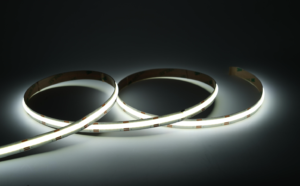
COB—or Chip on Board—LED strips use a high density of light-emitting elements to create a more continuous appearance than many traditional LED strip designs.
When combined with an appropriate aluminium profile and diffuser, COB strips can produce a sophisticated linear-lighting effect.
This makes them particularly attractive for:
- Luxury patios
- Outdoor kitchens
- Architectural ceilings
- Pergolas
- Cabinet lighting
- Bar areas
- Outdoor entertaining spaces
24V LED Strip Lights for Larger Outdoor Projects
For many architectural strip-lighting installations, 24V LED strips are worth considering.
For the same power, a 24V system draws approximately half the current of an equivalent 12V system.
This can be advantageous when designing longer LED strip runs, although maximum run length still depends on the specifications of the particular LED strip.
Always check the manufacturer’s maximum recommended run length.
Avoid Voltage Drop on Long Patio Installations
Long outdoor areas can require several metres of LED strip.
One issue that can occur on long runs is voltage drop.
You may notice that the LED strip is bright near the power connection but becomes progressively dimmer toward the other end.
Depending on the system, solutions can include:
- Using shorter strip runs
- Supplying power from multiple locations
- Powering from both ends where appropriate
- Using correctly sized cable
- Selecting an appropriate voltage
- Following the manufacturer’s maximum run length
- Correctly positioning the power supply
For large patios and commercial outdoor areas, planning the electrical layout before installation is particularly important.
Where Should the LED Driver Be Installed?
The power supply or LED driver is just as important as the LED strip.
A water-resistant LED strip should not be paired with an indoor-only driver placed somewhere exposed to rain or moisture.
Check the driver’s IP rating, installation instructions and environmental requirements.
Where possible, drivers and controllers should be installed in an appropriate protected, ventilated and accessible location.
Accessibility is also important for future servicing or replacement.
Best Places to Install LED Strips Around a Patio
1. Under Outdoor Kitchen Benches
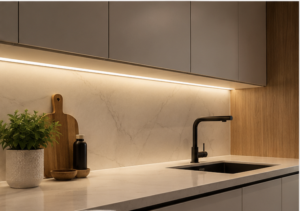
Installing LED strips underneath an outdoor kitchen bench can create subtle architectural illumination while helping define the cabinetry.
Warm white is particularly effective around stone and timber finishes.
2. Under Overhead Cabinets
LED strip lighting can provide practical illumination over preparation areas.
A neutral white such as 4000K may be appropriate where visibility is the priority.
3. Around Pergolas
LED strips can be integrated into pergola structures to provide discreet overhead illumination.
Using aluminium profiles can make the lighting appear integrated into the architecture rather than added afterwards.
4. Along Steps
LED strip lighting can help highlight changes in level while also creating an attractive floating-light effect.
5. Under Seating
Installing strips beneath fixed benches can create soft indirect lighting without introducing glare at eye level.
6. Around Patio Ceilings
Linear lighting around a ceiling or architectural recess can visually define the entire outdoor entertaining area.
Warm White vs RGB: Which Is Better?
There isn’t one answer for every patio.
For a sophisticated residential installation, 2700K–3000K warm white provides an inviting atmosphere.
For task-oriented areas such as an outdoor kitchen, a more neutral white may be useful.
For entertaining, RGB or RGB+CCT LED strips provide greater flexibility.
Many projects can also combine these approaches.
For example:
3000K architectural lighting + RGB feature lighting
This provides comfortable everyday lighting while retaining the ability to create colour effects for entertaining.
Common Outdoor LED Strip Lighting Mistakes
Even a high-quality LED strip can perform poorly if the overall installation isn’t properly planned.
Common mistakes include:
- Using indoor LED strips outdoors
- Choosing an inadequate IP rating
- Leaving strip ends or connections unprotected
- Using indoor connectors in exposed locations
- Installing an unsuitable driver outdoors
- Ignoring maximum strip run lengths
- Using undersized cable
- Failing to account for voltage drop
- Installing strips on unsuitable surfaces
- Assuming an aluminium profile is automatically waterproof
- Using incompatible controllers and drivers
The best results come from treating the lighting as a complete system rather than simply selecting an LED strip.
Choosing Water-Resistant LED Strip Lights for Sydney Conditions
Sydney patios can experience strong sunlight, rain, humidity and significant seasonal temperature changes.
For that reason, consider the actual location of the installation rather than simply selecting something labelled “outdoor.”
Ask:
Is the strip completely covered?
A protected patio installation may have different requirements from an exposed installation.
Can rain reach the strip?
Wind-driven rain can reach areas that initially appear protected.
Could water collect around the installation?
Drainage and mounting orientation should be considered.
Where are the connections?
Joins and cable entry points need suitable protection.
Where is the driver located?
It should be appropriate for its installation environment.
Will the strip be exposed to direct sunlight?
Check the manufacturer’s environmental and temperature specifications.
Water-Resistant LED Strip Lighting from Vesta Lines
Vesta Lines provides LED strip lighting components for residential, commercial and architectural projects.
A complete outdoor LED strip lighting system may include:
- Water-resistant LED strip lights
- COB waterproof LED strip lights
- RGB and RGB+CCT LED strips
- Aluminium LED profiles
- Diffusers
- IP-rated LED strip connectors
- LED drivers and power supplies
- Controllers
- Dimming equipment
- Mounting accessories
Selecting compatible components is particularly important for outdoor installations.
Frequently Asked Questions
Are waterproof LED strip lights suitable for outdoor patios?
Yes, provided the LED strip and the complete installation are appropriately rated and installed for the environmental conditions.
Is IP65 waterproof?
IP65 provides protection against dust and water jets under defined test conditions. It should not be treated as equivalent to a product rated for immersion.
Is IP67 better than IP65 for outdoor LED strips?
IP67 provides a higher level of water ingress protection than IP65. However, the appropriate rating depends on the installation environment rather than simply choosing the highest number.
Can I use waterproof LED strip lights around an outdoor kitchen?
Yes. LED strip lighting can work very well under cabinets, benches and architectural features. Select products and installation methods appropriate for the location, heat exposure and moisture conditions.
What colour temperature is best for a patio?
For residential entertaining areas, 2700K or 3000K can create a warm atmosphere. For outdoor kitchens and task areas, 4000K may provide a cleaner, brighter appearance.
Should outdoor LED strips use aluminium profiles?
Aluminium profiles aren’t required for every installation, but they can provide a cleaner appearance, improved physical protection and better heat management.
Can outdoor LED strip lights be dimmed?
Yes, if the LED strip, driver and controller are compatible with the chosen dimming system.
Do I need an electrician to install outdoor waterproof LED strip lights?
Electrical work involving mains-voltage connections and fixed wiring must comply with applicable Australian requirements. Use an appropriately licensed electrical professional where required.
Create Your Sydney Patio Lighting with Vesta Lines
The best patio lighting combines the right LED strip, suitable IP protection, correct power supply, quality connections and thoughtful installation.
Whether you’re illuminating a small balcony, outdoor kitchen, pergola or complete alfresco entertaining area, Vesta Lines can help you select LED strip lighting components for your project.
Explore Vesta Lines LED strip lights, aluminium profiles, waterproof connectors and lighting accessories for your next Sydney outdoor lighting project.
IP65 vs IP67 vs IP68 LED Strip Lights
Choosing the correct IP rating for outdoor LED strip lighting is essential, particularly around patios, gardens, swimming pools and water features.
The three ratings commonly considered for outdoor LED strip applications are IP65, IP67 and IP68.
| IP Rating | Water Protection | Typical LED Strip Applications |
|---|---|---|
| IP65 | Protected against water jets | Covered patios, pergolas, outdoor kitchens and sheltered outdoor areas |
| IP67 | Protected against temporary immersion under specified test conditions | Exposed outdoor areas, landscaping, wet environments and locations where temporary water exposure is possible |
| IP68 | Designed for continuous immersion under conditions specified by the manufacturer | Swimming pools, fountains, ponds and underwater lighting—but only where the product is specifically approved for that application |
The correct choice depends on the actual installation environment.
IP65 LED Strip Lights – Patios & Outdoor Areas
IP65 LED strip lights are a good option for many outdoor architectural lighting applications where the strip needs protection from dust, moisture and water jets but will not be submerged.
Typical applications include:
- Covered patios
- Alfresco entertaining areas
- Pergolas
- Outdoor kitchens
- Under outdoor cabinets
- Covered balconies
- Outdoor bar areas
- Protected architectural features
For a Sydney patio that is reasonably protected from direct rain, an appropriately specified IP65 LED strip may be suitable.
However, IP65 should not be used for underwater applications.
IP67 LED Strip Lights – Exposed Outdoor & Wet Areas
Where an installation is more exposed to rain or temporary water exposure, an IP67 LED strip may be more appropriate.
IP67 products are designed to provide a higher degree of protection against water ingress, including temporary immersion under specified test conditions.
Potential applications include:
- Exposed patios
- Landscape lighting
- Garden features
- Outdoor stairs
- Building façades
- Outdoor cabinetry
- Wet-area architectural lighting
- Areas exposed to rain
Vesta Lines also offers IP67 waterproof connectors for compatible LED strip systems, helping provide appropriately protected connections in outdoor installations.
However, there is an important distinction:
IP67 does not mean the product is designed for permanent underwater operation.
For swimming pools, ponds and continuously submerged installations, look for an appropriately specified IP68 product designed for underwater use.
IP68 LED Strip Lights for Swimming Pools & Underwater Lighting
For applications where the LED strip will remain underwater, such as swimming pools, fountains, ponds or water features, an appropriately designed IP68 LED lighting system is required.
IP68 represents protection for continuous immersion, but the exact permitted depth and duration are specified by the manufacturer.
This means you should not choose a product simply because the packaging says “IP68.”
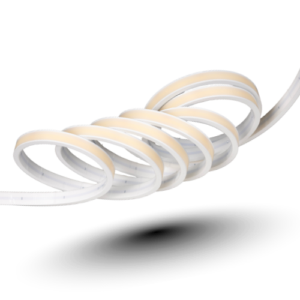
Cerian 15W Flexi LED Strip lights IP68
For underwater applications, confirm:
- Maximum permitted immersion depth
- Continuous immersion suitability
- Water temperature limits
- Chlorinated-water compatibility
- Salt-water compatibility where applicable
- Cable and termination requirements
- Operating voltage
- Driver requirements
- Installation instructions
- Applicable Australian electrical requirements
Swimming Pool LED Strip Lighting
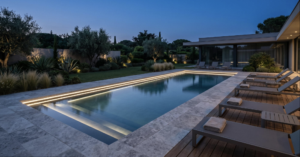
LED strip lighting can create impressive architectural effects around swimming pools.
Depending on the specific product and installation design, applications can include:
- Pool edges
- Steps
- Underwater architectural details
- Water features
- Fountains
- Pool surrounds
- Spa areas
- Landscape features around the pool
For lighting that will actually be inside the swimming pool or continuously underwater, use only a lighting product specifically designed and approved for swimming-pool or underwater use.

An ordinary IP68-rated general-purpose LED strip should not automatically be assumed suitable for a swimming pool.
IP68 Underwater LED Strip Lights
Underwater lighting has additional requirements beyond water resistance.
The entire system needs to be considered:
IP68 LED strip → waterproof connections → suitable cable → appropriate power supply → control system → correctly sealed installation
A weak point anywhere in this system can compromise the installation.
Particular attention should be given to the ends of the strip and electrical connections. Cutting an encapsulated waterproof LED strip can affect its original ingress protection unless the cut end is resealed using the manufacturer’s specified method.
Can IP68 LED Strip Lights Be Used in Saltwater Pools?
Only if the manufacturer specifically confirms the product is suitable for the environment.
An IP68 rating describes resistance to water ingress under specified conditions. It does not by itself establish resistance to salt, chlorine, chemicals, UV exposure or corrosion.
This is particularly important for Sydney properties with:
- Saltwater swimming pools
- Chlorinated pools
- Spas
- Coastal installations
- Seaside properties
For these environments, check the manufacturer’s material and chemical-resistance specifications before installation.
Which IP Rating Do I Need?
A simple way to think about it is:
Covered patio → consider IP65
Exposed outdoor/wet area → consider IP67
Continuous underwater application → appropriately specified IP68
Inside a swimming pool → IP68 product specifically designed and approved for swimming-pool/underwater use
The actual product specification and installation environment should always determine the final selection.
Swimming Pool Electrical Safety
Swimming pools require more careful electrical design than ordinary patio lighting.
Even when the waterproof LED strip lights itself operates at low voltage, the driver, transformer, controls, cabling, connections, installation location and electrical separation all need to be suitable for the pool environment.
In Australia, swimming-pool electrical installations are subject to specific electrical safety requirements. Pool and underwater lighting should therefore be designed and installed by appropriately qualified professionals in accordance with applicable requirements.
Do not assume that using a 12V or 24V LED strip by itself makes a swimming-pool installation safe.
Best Water-Resistant LED Strip Lights for Sydney Outdoor Areas
For Sydney homes and commercial projects, Vesta Lines can provide different LED strip lighting solutions depending on the installation environment.
Patio & Alfresco Areas
Consider IP65 waterproof LED strip lights for appropriately protected locations.
Exposed Outdoor Areas
Consider IP67 LED strips where greater water-ingress protection is required.
Swimming Pools & Underwater Applications
Use an IP68 lighting product specifically designed for continuous underwater or swimming-pool installation.
Outdoor Architectural Lighting
Combine appropriately rated LED strips with aluminium profiles, suitable connectors, drivers and controllers to create a complete lighting system.
The most important principle is to choose the entire lighting system for the environment, rather than selecting an LED strip based only on its IP rating.