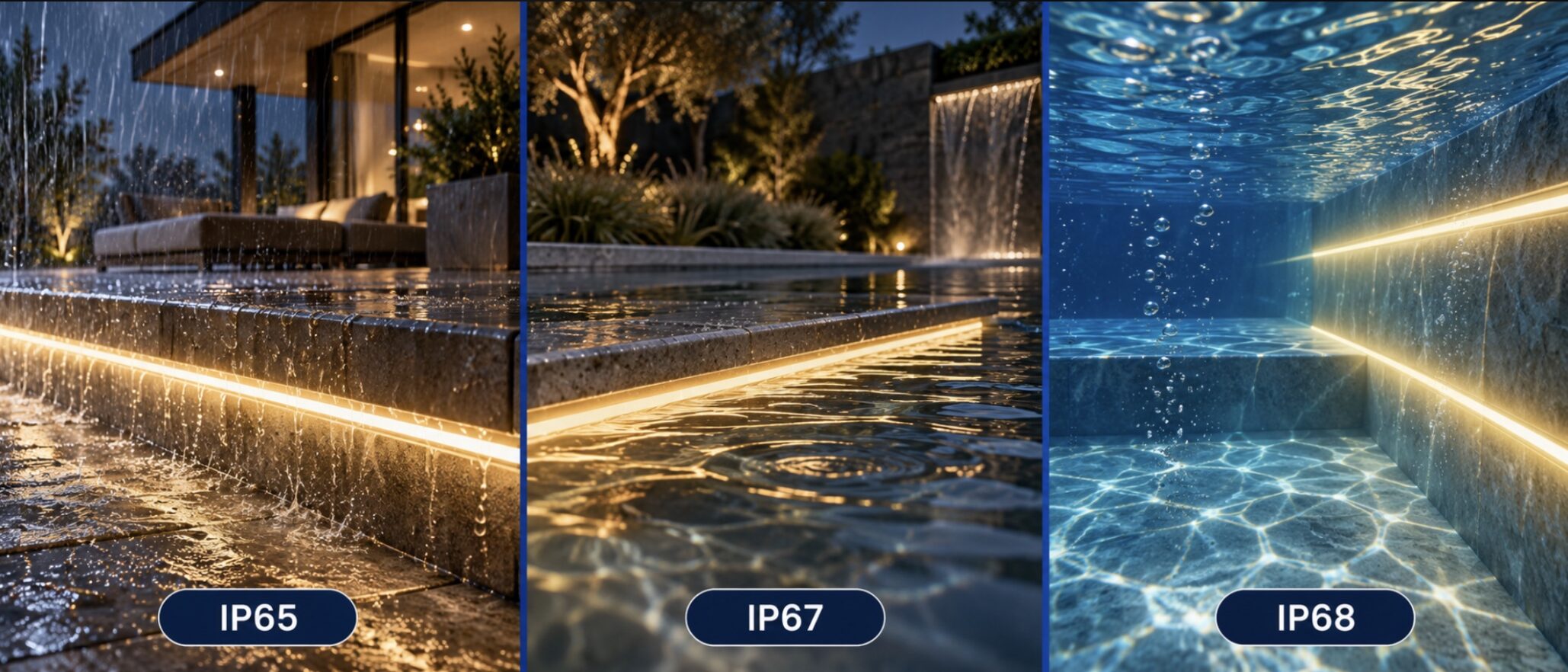
Choosing the right waterproof LED strip can make a major difference to the performance and lifespan of an outdoor lighting installation. If you are comparing IP65 vs IP67 vs IP68, it is important to understand what each rating means and where each type of LED strip should be used.
LED strip lights are available with different levels of protection against dust and water. An IP65 LED strip can be suitable for many covered outdoor areas, while an IP67 LED strip provides greater protection for exposed and wet environments. IP68 LED strip lights are designed for continuous immersion under specific conditions set by the manufacturer.
However, the IP rating is only one part of an outdoor LED lighting system. Connectors, cable entries, end caps, power supplies, controllers and installation methods also need to be suitable for the environment.
In this guide, we explain IP65 vs IP67 vs IP68 LED strip lights, how the ratings work, where each type can be used and what to consider when installing waterproof LED strip lighting.
What Does an IP Rating Mean?
IP stands for Ingress Protection.
An IP rating is used to describe how well an electrical product is protected against the entry of solid particles and water.
The rating normally contains two numbers.
For example:
IP65
The first number relates to protection against solid objects and dust.
The second number relates to protection against water.
This means the complete rating provides information about two different types of protection.
When choosing LED strip lighting, you should consider both parts of the rating as well as the manufacturer’s installation instructions.
Understanding the Two Numbers in an IP Rating
The first number: protection against solids
The first digit indicates protection against solid particles and contact.
For outdoor LED strip lighting, a high first digit is useful because dust, dirt and other particles can affect equipment.
The second number: protection against water
The second digit indicates the level of protection against water.
This is particularly important when installing LED strip lights outdoors.
Rain, water spray, cleaning, splashing and immersion can expose LED lighting to very different conditions.
Therefore, an LED strip designed for a covered patio may not be suitable for an exposed garden, wet area or underwater installation.
IP65 LED Strip Lights Explained
IP65 LED strip lights provide protection against dust and water jets from different directions under the applicable test conditions.
They are commonly considered for outdoor areas where the strip may experience rain or water spray but is not intended for continuous immersion.
Typical applications can include:
- Covered patios
- Alfresco areas
- Outdoor kitchens
- Pergolas
- Eaves
- Architectural features
- Covered walkways
- Decorative outdoor lighting
- Sheltered signage
- Cabinet and joinery applications where moisture protection is required
IP65 can be a practical choice when the strip is protected from standing water and continuous immersion.
However, the installation still needs suitable connections and terminations.
View Vesta Lines IP65 COB LED Strip Lights
IP67 LED Strip Lights Explained
IP67 LED strip lights provide a higher level of water protection than IP65 products.
They are designed to withstand temporary immersion under specified test conditions.
This can make IP67 LED strips suitable for applications where the lighting may experience greater exposure to water.
Potential applications include:
- Exposed outdoor areas
- Gardens
- Outdoor pathways
- Pergolas
- Landscaping
- Outdoor architectural lighting
- Areas exposed to heavy rain
- Wet decorative applications
- Some installations where temporary water exposure is possible
However, IP67 does not mean that the LED strip can remain underwater continuously.
The manufacturer’s specifications must always be checked before using an IP67 product in a particular environment.
View Vesta Lines IP67 COB LED Strip Lights
IP68 LED Strip Lights Explained
IP68 provides a higher level of protection for continuous immersion.
However, there is an important point to understand:
IP68 does not have one universal depth or duration for every product.
The manufacturer defines the conditions under which the product meets its IP68 rating.
These conditions may include:
- Maximum installation depth
- Maximum immersion duration
- Water temperature
- Installation method
- Cable arrangement
- Connection method
- Product orientation
- Other manufacturer requirements
Therefore, you should always check the specific product documentation before installing an IP68 LED strip underwater.
View Vesta Lines IP68 COB LED Strip Lights
IP65 vs IP67 vs IP68: What’s the Difference?
The easiest way to understand IP65 vs IP67 vs IP68 is to look at the intended water exposure.
| IP Rating | General Water Protection | Typical Application |
|---|---|---|
| IP65 | Protection against water jets | Covered outdoor areas and sheltered installations |
| IP67 | Protection against temporary immersion under specified conditions | More exposed or wet outdoor areas |
| IP68 | Protection for continuous immersion under specified conditions | Suitable underwater applications when specifically approved |
These descriptions are general.
Always follow the manufacturer’s stated conditions for the specific LED strip.
IP65 vs IP67: What’s the Difference?
The main difference between IP65 and IP67 is immersion protection.
IP65 is designed for protection against water jets.
IP67 adds protection against temporary immersion under specified conditions.
This does not necessarily mean that an IP67 LED strip is always the right choice for every outdoor installation.
For example, a covered patio may not need the same protection as a garden feature that receives direct rain.
Consider IP65 when:
- The area is sheltered
- The strip is protected from standing water
- The main concern is rain or water spray
- The installation is under an eave or covered patio
Consider IP67 when:
- The strip is more exposed to weather
- Heavy rain is expected
- The installation is in a wet outdoor location
- Temporary water immersion is possible
The final choice should always be based on the actual environment and product specifications.
IP67 vs IP68: What’s the Difference?
The difference between IP67 and IP68 is mainly related to immersion.
IP67 is designed for temporary immersion under specified test conditions.
IP68 is designed for continuous immersion under manufacturer-defined conditions.
Therefore, IP68 may be considered for certain underwater installations, but you should never assume that every IP68 LED strip is suitable for every underwater application.
Before installing IP68 lighting, check the manufacturer’s requirements for depth, duration, water temperature and connections.
Is IP65 Waterproof?
The term waterproof can sometimes be misleading.
An IP65 LED strip has protection against water jets under the applicable test conditions. It is not designed for continuous immersion.
Therefore, an IP65 LED strip should not be treated as an underwater LED strip.
For outdoor applications, IP65 can be suitable when the strip is installed in an environment where it will experience rain or water spray without being submerged.
Is IP67 Waterproof?
IP67 provides a higher level of water protection than IP65 and includes temporary immersion under specified conditions.
However, IP67 should not be treated as suitable for continuous underwater operation.
If an installation requires continuous immersion, check whether an appropriately specified IP68 product is available.
Is IP68 Suitable for Underwater Lighting?
An IP68 LED strip may be suitable for underwater use only when the specific product is designed and approved for that application.
IP68 conditions vary between products.
Before using an IP68 strip underwater, check:
- Approved immersion depth
- Approved immersion duration
- Water temperature
- Cable and termination requirements
- Connection method
- Power supply requirements
- Installation instructions
- Compatibility with the water environment
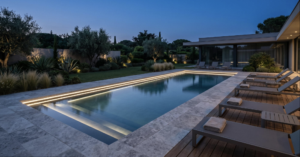
This is particularly important for swimming pools, fountains and other permanent water installations.
Can IP68 LED Strip Lights Be Used in Swimming Pools?
This is one of the most important questions when comparing IP65 vs IP67 vs IP68.
A general IP68 rating does not automatically mean that an LED strip is approved for swimming-pool installation.
Swimming pools can expose lighting equipment to:
- Continuous water
- Chlorine
- Salt
- Cleaning chemicals
- UV exposure
- Temperature changes
- Corrosion
Therefore, a product intended for pool use needs to be specifically suitable for that environment.
The complete electrical installation also matters.
The LED strip is only one part of the system. The power supply, transformer or driver, cables, connectors, controls and electrical separation all need to be considered.
Where electrical safety requirements apply, installation should be completed by an appropriately qualified professional in accordance with applicable Australian requirements.
IP65 vs IP67 vs IP68 for Outdoor Patios
Outdoor patios and alfresco areas are common locations for LED strip lighting.
LED strips can be installed under:
- Benches
- Kitchen cabinets
- Outdoor kitchens
- Pergolas
- Steps
- Seating
- Ceiling recesses
- Shelves
- Bar counters
- Architectural features
The correct IP rating depends on how exposed the installation is.
Covered patio
For a well-protected area with limited direct rain exposure, an IP65 product may be suitable depending on the installation.
Exposed patio
If the strip receives direct rain and greater water exposure, an IP67 option may provide a higher level of protection.
Continuous underwater use
For continuous immersion, use only a product specifically designed for that purpose, with the manufacturer’s IP68 conditions followed.
Waterproof LED Strip Lights for Outdoor Kitchens
Outdoor kitchens often combine lighting with water, heat and weather exposure.
LED strip lighting can be installed beneath:
- Benchtops
- Cabinets
- Shelves
- Bar counters
- Outdoor kitchen structures
When selecting an LED strip for an outdoor kitchen, consider where the strip will be positioned.
A strip underneath a fully protected cabinet may have different requirements from one directly exposed to rain.
Also consider:
- Water splash
- Cleaning
- Heat
- Grease
- Direct sunlight
- Cable routing
- Connector protection
A suitable aluminium profile can also provide a clean finish and help with heat management.
Waterproof LED Strip Lights for Gardens and Landscaping
Outdoor LED strip lights can be used to highlight garden and landscape features.
Potential applications include:
- Garden edges
- Steps
- Planter boxes
- Pathways
- Retaining walls
- Outdoor structures
- Decorative architectural features
Because landscaping installations can be directly exposed to rain and moisture, a suitable IP rating is important.
IP67 products may be considered for more exposed areas where greater water protection is required.
However, the connections and cable entries need equal attention.
Waterproof LED Strip Connectors and Connections
One of the most common mistakes in outdoor LED strip installation is focusing only on the IP rating of the strip.
For example, you could install an IP67 LED strip but then connect it using an unsuitable connector.
The connection can become the weak point in the system.
Outdoor installations should consider:
- Strip-to-strip connections
- Strip-to-wire connections
- Corner connections
- End caps
- Cable entries
- Sealing methods
- Controller connections
- Power supply connections
Use suitable connectors and termination methods for the selected strip and environment.
View Vesta Lines LED Strip Connectors
View Waterproof 10mm LED Strip Connectors
Does an Aluminium Profile Make an LED Strip Waterproof?
No.
An aluminium profile can provide:
- Physical protection
- Heat management
- A cleaner appearance
- Straight installation
- Diffuser compatibility
- Reduced visibility of LED points
However, an aluminium profile does not automatically change the IP rating of an LED strip.
If the installation requires water protection, the strip, connections, end caps and installation method all need to be suitable.
View Vesta Lines Aluminium Extrusion Profiles
COB vs SMD Waterproof LED Strip Lights
Waterproof LED strips are available using different LED technologies.
COB LED strips can provide a smooth and continuous light appearance, which is useful for architectural and decorative installations.
SMD LED strips use individual LED packages and are available in many different configurations.
For outdoor installations, the IP rating is separate from the COB or SMD technology.
For example, you can have:
- IP65 COB
- IP67 COB
- IP68 COB
- IP-rated SMD products
Therefore, do not choose an outdoor strip based only on whether it is COB or SMD.
Consider both the lighting technology and the required environmental protection.
Waterproof LED Strip Lights and Direct Sunlight
Water protection is not the only consideration for outdoor LED strip lighting.
Direct sunlight can expose the product to:
- UV radiation
- Heat
- Temperature changes
When installing LED strip lighting outdoors, check the manufacturer’s suitability for the intended environment.
A strip installed under a shaded outdoor cabinet can experience very different conditions from a strip installed in direct sunlight all day.
Also consider heat management.
Higher-power LED strips can produce more heat, so an aluminium profile may be important for suitable installations.
Choosing the Right Power Supply for Waterproof LED Strip Lights
The LED strip is only one part of the lighting system.
The power supply must match the LED strip’s:
- Voltage
- Total power requirement
- Installation environment
- Control system
- Protection requirements
For example, if an LED strip uses 10W per metre and you install 10 metres:
10W × 10m = 100W
The power supply should then be selected based on the manufacturer’s requirements and appropriate system design.
For outdoor applications, also consider where the power supply will be installed.
Do not place an indoor-rated power supply in an exposed location.
Vesta Lines also offers suitable LED strip drivers for different applications.
View Vesta Lines 24V LED Drivers
Voltage Drop in Long Waterproof LED Strip Runs
Long LED strip runs can experience voltage drop.
Voltage drop can cause the LEDs further away from the power source to appear dimmer or produce inconsistent light.
This can be particularly important for large outdoor installations.
Possible solutions include:
- Keeping runs within the manufacturer’s recommended maximum
- Using appropriate cable sizes
- Adding power injection where required
- Feeding the strip from suitable points
- Using a suitable voltage system
- Planning the power supply location carefully
Always check the product’s maximum recommended run length before installation.
Cutting Waterproof LED Strip Lights
Waterproof LED strips need special care when cutting.
If an encapsulated or sealed LED strip is cut incorrectly, the original water protection may be affected.
Before cutting a waterproof LED strip:
- Check the manufacturer’s cutting instructions.
- Cut only at the designated cutting points.
- Use the correct end cap or sealing method.
- Ensure the new termination is properly sealed.
- Check whether the manufacturer permits the strip to be cut and resealed.
Do not assume that cutting an IP67 or IP68 strip will leave the cut end waterproof.
Common Mistakes When Installing Waterproof LED Strip Lights
1. Using an indoor LED strip outdoors
An IP20 indoor strip is not automatically suitable for outdoor use.
Choose a product designed for the environment.
2. Choosing the IP rating without considering the installation
A covered patio and an exposed garden feature can have very different requirements.
3. Ignoring connectors
The connector may be exposed to water even when the strip itself is protected.
4. Assuming IP67 means permanent underwater use
IP67 is intended for temporary immersion under specified conditions, not continuous immersion.
5. Assuming every IP68 strip is pool approved
IP68 conditions vary by product.
Always check the manufacturer’s specifications.
6. Installing the wrong power supply outdoors
The power supply needs to be suitable for its actual installation environment.
7. Ignoring direct sunlight
UV exposure and heat can affect outdoor lighting products.
8. Ignoring voltage drop
Long runs need proper electrical planning.
9. Cutting and resealing incorrectly
An incorrectly sealed cut can compromise the product’s water protection.
10. Assuming an aluminium profile makes the installation waterproof
Profiles provide many benefits, but they do not automatically waterproof an LED strip system.
IP65 vs IP67 vs IP68: Quick Decision Guide
| Installation | Rating to Consider |
|---|---|
| Dry indoor area | IP20 or appropriate indoor rating |
| Sheltered outdoor area | IP65 |
| Covered patio | IP65 |
| Outdoor kitchen | IP65 or IP67 depending on exposure |
| Exposed outdoor area | IP67 |
| Garden or landscape feature | IP67 depending on conditions |
| Area exposed to heavy rain | IP67 may be appropriate |
| Temporary immersion | IP67 under specified conditions |
| Continuous underwater installation | IP68 under specified conditions |
| Swimming pool | Specifically approved pool/underwater product |
| Fountain | Product specifically suitable for the application |
| Saltwater environment | Check chemical and corrosion compatibility |
This table is a general guide. The product manufacturer’s specifications should always take priority.
How to Choose the Right IP Rating
Before ordering an LED strip, ask these questions:
1. Is the installation indoors or outdoors?
Indoor installations may require less water protection.
2. Is the area covered?
A covered alfresco area may have less direct exposure than an open patio.
3. Will the strip receive direct rain?
If yes, consider a product with suitable outdoor water protection.
4. Could the strip become temporarily submerged?
If yes, check whether the product is suitable for temporary immersion.
5. Will the strip stay underwater?
If yes, use only a product specifically designed for continuous immersion.
6. Is the installation near a swimming pool?
Check whether the product is specifically approved for the intended pool environment.
7. Are the connectors protected?
The strip and its connections need to be considered as part of the complete installation.
8. Where will the power supply be installed?
Make sure the driver or power supply is suitable for its location.
9. Is the strip exposed to direct sunlight?
Check the manufacturer’s suitability for UV and temperature exposure.
IP65 vs IP67 vs IP68: Frequently Asked Questions
What is the difference between IP65, IP67 and IP68?
IP65 provides protection against water jets. IP67 provides protection against temporary immersion under specified conditions. IP68 provides protection for continuous immersion under manufacturer-defined conditions.
Is IP65 suitable for outdoor LED strip lighting?
IP65 can be suitable for many sheltered outdoor installations, such as covered patios, alfresco areas and outdoor architectural lighting. The complete installation must still use suitable connections and power equipment.
Is IP67 better than IP65?
IP67 provides a higher level of water protection for immersion than IP65. However, that does not mean it is necessary for every installation. The appropriate rating depends on the environment.
Is IP68 better than IP67?
IP68 provides protection for continuous immersion under specified manufacturer conditions, while IP67 covers temporary immersion under specified conditions. The appropriate choice depends on the application.
Can IP67 LED strips go underwater?
IP67 products are designed for temporary immersion under specified conditions. They should not automatically be used for continuous underwater applications.
Can IP68 LED strips go underwater?
An IP68 LED strip may be suitable for underwater use when the specific product is designed and approved for that application. Always check the manufacturer’s depth, duration and installation requirements.
Is IP68 suitable for a swimming pool?
Not automatically. A general IP68 rating does not by itself confirm suitability for swimming-pool installation. Use a product specifically designed and approved for the intended pool environment.
Does IP65 mean waterproof?
IP65 provides protection against water jets under the applicable test conditions. It does not mean the product can be continuously submerged.
Does an aluminium profile waterproof LED strip?
No. An aluminium profile can improve protection, heat management and appearance, but it does not automatically make an LED strip waterproof.
Are waterproof connectors necessary for outdoor LED strips?
Suitable connectors and termination methods are important for outdoor installations. The connection should be appropriate for the strip’s IP rating and the environment.
Can I cut an IP67 or IP68 LED strip?
Some waterproof LED strips can be cut at designated points, but cutting can affect water protection. Follow the manufacturer’s instructions and use the correct sealing method.
What IP rating is best for a patio?
The correct rating depends on how exposed the patio is. A sheltered patio may suit IP65, while a more exposed area may require IP67. Always assess the actual environment.
Vesta Lines Waterproof and Outdoor LED Strip Lighting
Vesta Lines offers LED strip lighting solutions for residential, commercial and architectural applications.
Our range includes options for indoor lighting, outdoor areas, architectural lighting, decorative applications and projects requiring higher water protection.
You can explore the full LED strip range here:
For smooth and continuous illumination, explore the COB LED strip range:
Vesta Lines COB LED Strip Lights
For outdoor applications, explore IP65 and IP67 options:
Vesta Lines IP65 COB LED Strips
Vesta Lines IP67 COB LED Strips
For applications requiring continuous immersion, review the manufacturer’s specifications for suitable IP68 products:
Vesta Lines IP68 COB LED Strips
You can also find profiles and connectors to help complete the installation:
Vesta Lines Aluminium Profiles
Vesta Lines LED Strip Connectors
Final Thoughts: IP65 vs IP67 vs IP68
Understanding IP65 vs IP67 vs IP68 makes it easier to choose LED strip lighting for different environments.
IP65 can be suitable for many sheltered outdoor applications where the strip may experience rain or water spray.
IP67 provides additional protection against temporary immersion and can be considered for more exposed or wet installations.
IP68 is designed for continuous immersion under specific manufacturer-defined conditions and may be suitable for certain underwater applications when the product is specifically approved for them.
However, choosing the correct IP rating is only part of a successful installation.
You should also consider the LED strip’s wattage, voltage, maximum run length, heat management, connectors, cable, power supply, controller, installation surface and exposure to sunlight or chemicals.
For swimming pools and other specialist underwater applications, do not rely on the IP rating alone. Check the complete product specifications and applicable electrical requirements.
By selecting the appropriate LED strip and matching it with suitable connections, power equipment and installation methods, you can create reliable lighting for patios, alfresco areas, outdoor kitchens, gardens, architectural features and other applications.