Best LED Strip Lights for Kitchen Cabinets & Benchtops
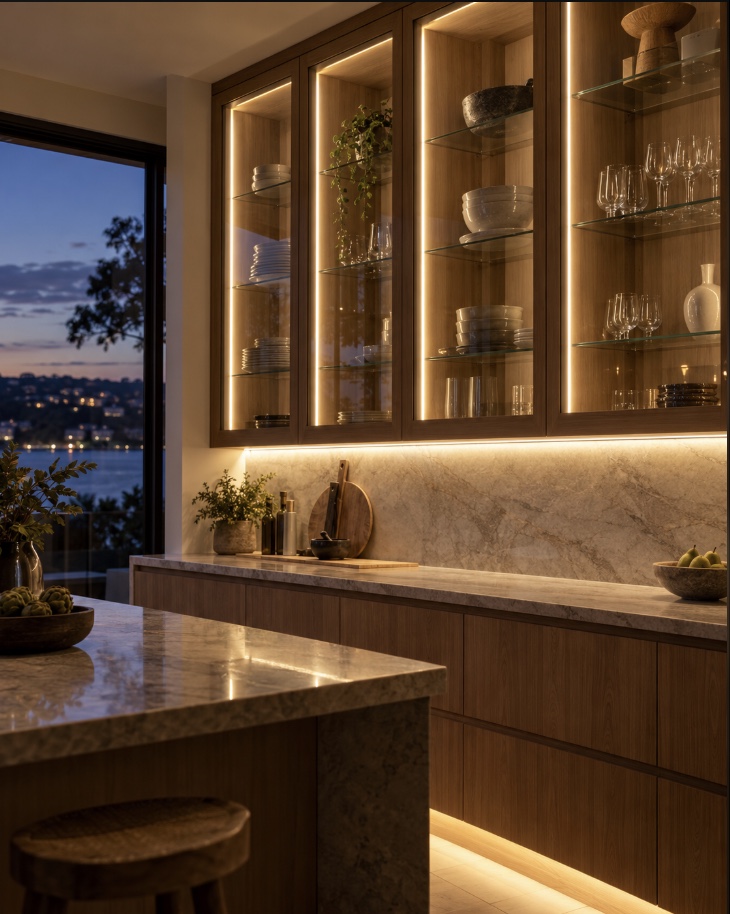
The right lighting can completely change the look and feel of a kitchen. In particular, LED strip lights for kitchen cabinets and benchtops can add useful task lighting while also creating a warm and modern look.
You can install LED strip lights under kitchen cabinets, along benchtops, inside cupboards, under shelves and around kitchen islands. However, choosing the right strip is important. Brightness, colour temperature, CRI, voltage, LED type and installation method can all affect the final result.
In this guide, we explain how to choose the best LED strip lights for kitchen cabinets and benchtops. We also cover LED strip types, colour temperatures, aluminium profiles, power supplies and common installation mistakes.
Why Use LED Strip Lights in a Kitchen?
Kitchen lighting needs to do more than look good. It also needs to provide enough light for cooking, preparing food and working on the benchtop.
LED strip lights can help fill dark areas under wall cabinets. As a result, they can make kitchen work areas easier to see.
They also offer several other benefits:
- Clean and modern appearance
- Even light across long areas
- Easy installation in many locations
- Low-profile design
- Good energy efficiency
- Different colour temperatures
- Dimmable options
- COB options for smooth, dot-free light
- Suitable options for cabinets and benchtops
Moreover, LED strips can work with aluminium profiles and diffusers. This creates a neat finish and helps protect the strip.
Where Can You Install LED Strip Lights in a Kitchen?
There are many places where LED strip lights for kitchen lighting can work well.
Under kitchen cabinets
This is one of the most popular uses.
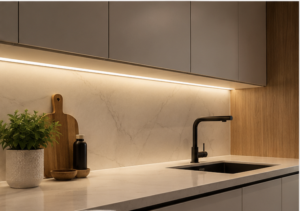
Install the strip under the wall cabinets to light the bench top below. This creates useful task lighting and reduces shadows while you prepare food.
Under kitchen shelves
LED strips can highlight open shelves and display areas.
They can also add soft light without taking up much space.
Inside kitchen cabinets
You can use LED strips inside cupboards to make stored items easier to see.
For example, strips can work well in tall cabinets, pantry areas and glass display cabinets.
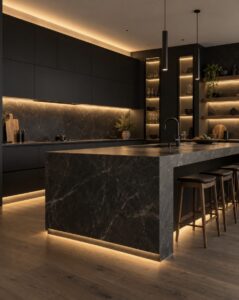
Kitchen island
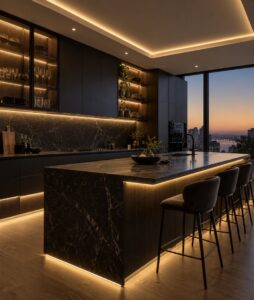
LED strip lights can add accent lighting around a kitchen island.
You can install them underneath the island, around the kick board or inside a recessed detail.
Kitchen bench top
LED strips can provide direct light across the working surface.
However, make sure the strip is positioned correctly so it does not shine directly into your eyes.
Kick boards
LED strips under kitchen cabinets can create a floating effect.
This works especially well in modern kitchens with simple cabinet designs.
What Are the Best LED Strip Lights for Kitchen Cabinets?
The best LED strip depends on the location and the result you want.
For many kitchen projects, 24V LED strip lights are a practical option. They can provide stable lighting and work well for longer runs than many 12V options.
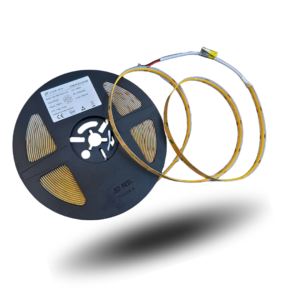
COB LED strips are also popular for kitchens because they create a smooth line of light.
When choosing a strip, look at:
- Wattage per metre
- Voltage
- Colour temperature
- CRI
- LED density
- Beam angle
- Dimming options
- Strip width
- Maximum run length
- Aluminium profile requirements
Therefore, do not choose an LED strip based only on wattage or price.
COB vs SMD LED Strip Lights for Kitchens
Two common LED strip technologies are COB and SMD.
Both can work well in kitchen lighting. However, they produce a different visual effect.
COB LED Strip Lights
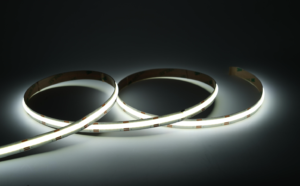
COB stands for Chip on Board.
COB strips place many LED chips closely together. This creates a more continuous line of light.
As a result, COB strips can reduce the visible dotted effect that you may see with some traditional SMD strips.
COB strips work especially well when you want:
- Smooth lighting
- A continuous light line
- Clean cabinet lighting
- Minimal visible LED points
- Modern kitchen designs
Explore Vesta Lines COB LED Strip Lights
SMD LED Strip Lights
SMD strips use individual LED packages placed along the strip.
They are available in many wattages, colours and LED densities.
A high-density SMD strip can provide good results. However, the LEDs may still be more visible when you look directly at the strip.
For kitchen cabinets, you can use an aluminium profile with a diffuser to create a cleaner appearance.
What Colour Temperature Is Best for Kitchen LED Strip Lights?
Colour temperature has a major effect on the appearance of your kitchen.
It is measured in Kelvin (K).
Common options include:
| Colour Temperature | Appearance | Common Kitchen Use |
|---|---|---|
| 2700K | Very warm white | Warm, relaxed kitchens |
| 3000K | Warm white | Cabinets and residential kitchens |
| 4000K | Neutral white | Benchtops and task lighting |
| 5000K | Cool white | Bright work areas |
| 6000K–6500K | Daylight white | Utility and high-visibility areas |
For many residential kitchens, 3000K or 4000K can work well.
3000K warm white
3000K gives the kitchen a warm and comfortable appearance.
It can work well with:
- Timber cabinets
- Warm flooring
- Neutral interiors
- Dining areas
- Decorative lighting
4000K neutral white
4000K provides a cleaner and more neutral appearance.
It can work well for:
- White kitchens
- Modern kitchens
- Benchtop lighting
- Task lighting
- Commercial-style interiors
If you are unsure, consider a CCT LED strip. This allows you to adjust the colour temperature between different settings.
View Vesta Lines CCT LED Strip Lighting
What CRI Should Kitchen LED Strip Lights Have?
CRI means Colour Rendering Index.
It describes how accurately a light source shows colours compared with a reference light source.
This matters in kitchens because food, vegetables, meat and other items can look different under poor-quality lighting.
For kitchen lighting, a CRI of 90 or higher can provide very good colour rendering.
For example, a high-CRI LED strip can help food and kitchen surfaces appear more natural.
Therefore, when comparing LED strips, do not look only at lumens and wattage. Check the CRI as well.
How Bright Should LED Strip Lights Be Under Kitchen Cabinets?
The right brightness depends on the application.
A decorative strip does not need the same output as a strip used for task lighting.
For example:
- Soft accent lighting can use lower output.
- Under-cabinet task lighting may need higher output.
- Large benchtops may need more even light.
- Display cabinets can use lower output for a softer effect.
The strip’s wattage per metre gives you an indication of power use, but it does not tell you the complete light output.
Therefore, also check the manufacturer’s lumen output per metre.
8W vs 10W vs 15W vs 20W LED Strip Lights
LED strips are available in different power levels.
For example, Vesta Lines offers different LED strip options for different lighting requirements.
8W LED strip

An 8W strip can work well for decorative lighting and areas that do not require very high output.
10W LED strip
A 10W strip can provide a good balance between brightness and power consumption for many applications.
15W LED strip

A 15W strip can provide higher output for applications that need stronger illumination.
20W LED strip
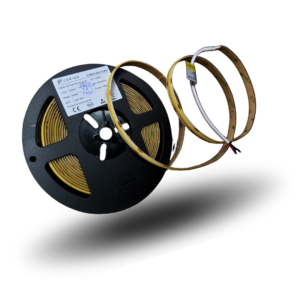
A 20W strip provides higher power and can suit applications that require strong, bright lighting.
However, higher wattage also means more heat.
Therefore, higher-power LED strips often need good heat management.
Do LED Strip Lights Need an Aluminium Profile?
For many kitchen installations, an aluminium LED profile is a very useful addition.
The profile can:
- Help manage heat
- Protect the LED strip
- Create a clean finish
- Hold the diffuser
- Improve installation
- Reduce direct visibility of the LEDs
- Help keep the strip straight
For example, an LED strip under a kitchen cabinet can sit inside a slim aluminium profile.
Then, a diffuser can soften the light and create a professional appearance.
View Vesta Lines Aluminium LED Profiles
Why Use a Diffuser With Kitchen LED Strip Lights?
A diffuser sits over the LED strip inside the aluminium profile.
It helps spread and soften the light.
This can be useful when installing SMD strips because it can reduce the visible LED points.
A diffuser can also create a smoother appearance across the entire length of the cabinet.
However, COB LED strips already provide a very smooth light output. Therefore, you may have more flexibility when choosing the profile and diffuser.
Choosing the Right LED Strip Width
LED strips come in different widths.
Common widths include:
- 8mm
- 10mm
- 12mm
- Other specialist sizes
The strip width must match the aluminium profile and accessories.
Before ordering, check:
- LED strip width
- Profile internal width
- Connector size
- Diffuser compatibility
- Installation space
This is especially important for kitchen joinery because available space can be limited.
24V LED Strip Lights for Kitchen Cabinets
A 24V LED strip can be a good choice for kitchen cabinet and benchtop lighting.
Vesta Lines offers a range of 24V LED strip products in different wattages and configurations.
A 24V system can also be useful for longer runs. However, the maximum run length still depends on the specific LED strip.
Therefore, always check the manufacturer’s recommended maximum length.
For longer installations, you may need to consider:
- Power injection
- Cable size
- Power supply location
- Voltage drop
- Separate strip runs
How to Choose the Right LED Driver
LED strip lights need a suitable power supply or driver.
First, check the strip voltage.
For example, if you use a 24V strip, select a compatible 24V driver.
Next, calculate the total power.
For example:
10W per metre × 5 metres = 50W
You then need a suitable driver for the total load.
It is also important to allow suitable capacity rather than operating a power supply continuously at its maximum rating.
For larger kitchen projects, you may need multiple drivers or separate lighting zones.
Vesta Lines offers a range of 24V LED drivers for LED strip installations.
View Vesta Lines LED Strip Drivers
Should Kitchen LED Strip Lights Be Dimmable?
Dimming can be very useful in a kitchen.
For example, you may want bright light while preparing food. Later, you may want softer light while entertaining.
A dimmable LED strip system can provide both options.
You can also divide the lighting into different zones.
For example:
- Under-cabinet lighting
- Island lighting
- Pantry lighting
- Display lighting
- Kickboard lighting
Each zone can then have its own control.
Smart controllers can also allow you to control compatible LED strip lights using a remote, phone or smart-home system.
Warm White vs Neutral White for Kitchen Cabinets
The choice between 3000K and 4000K is common for residential kitchens.
Choose 3000K when you want:
- A warmer appearance
- A comfortable atmosphere
- Better matching with timber
- Softer evening lighting
Choose 4000K when you want:
- Neutral white light
- Clear task lighting
- A modern appearance
- Good visibility across the benchtop
If your kitchen uses both task and decorative lighting, consider using separate lighting zones.
LED Strip Lights for Kitchen Benchtops
Benchtop lighting needs careful positioning.
If you install the strip too far back, the front of the benchtop may remain dark.
If you install it too far forward, you may see the strip or experience glare.
A good installation usually places the strip under the front section of the wall cabinet or in a suitable recessed profile.
The exact position depends on:
- Cabinet depth
- Benchtop depth
- Profile type
- Diffuser
- Beam angle
- Strip brightness
Therefore, test the position before completing the final installation.
LED Strip Lights Under Kitchen Cabinets
Under-cabinet lighting is one of the easiest ways to improve kitchen visibility.
The strip can run along the underside of the cabinet.
For a clean finish, install it inside an aluminium profile.
You can then hide the cable inside the cabinet or joinery where possible.
For a seamless appearance, COB LED strip lighting can work particularly well.
LED Strip Lights Inside Kitchen Cabinets
LED strip lights can also make storage areas easier to use.
You can install strips:
- Along cabinet sides
- Under shelves
- Inside tall cabinets
- Around pantry shelves
- Inside display cabinets
For cabinet doors that open and close regularly, consider the cable path carefully.
Also, make sure the strip does not interfere with shelves, hinges or stored items.
LED Strip Lights for Kitchen Islands
Kitchen islands are often a major feature of modern kitchens.
LED strips can highlight the island without adding bulky fixtures.
You can install strips:
- Under the island
- Around the kick board
- Under the bench top
- Inside recessed sections
For a floating effect, install the strip close to the lower edge of the island.
A diffuser can help create a smooth line of light.
Are IP-Rated LED Strips Needed in a Kitchen?
Not every kitchen needs a waterproof LED strip.
For a normal indoor kitchen cabinet, an indoor-rated strip can often be suitable when installed away from direct water.
However, areas close to sinks or locations where water can splash may need additional protection.
The right choice depends on the exact installation.
For outdoor kitchens or areas exposed to rain, you should consider an appropriate outdoor IP rating.
For example, Vesta Lines offers IP65 and IP67 LED strip options for applications requiring greater protection from moisture.
View Vesta Lines IP65 LED Strip Lights
View Vesta Lines IP67 LED Strip Lights
Kitchen LED Strip Light Installation Tips
Good planning can make a major difference.
1. Plan the cable route first
Before installing the strip, decide where the driver will sit.
Then plan how the cables will reach each lighting zone.
2. Measure the cabinet length
Measure each section before ordering the LED strip.
Do not assume every cabinet has the same length.
3. Choose the profile before cutting
Make sure the strip, profile and diffuser work together.
4. Test the lighting position
Temporarily position the strip before final installation.
This helps you check for shadows and glare.
5. Check the voltage
Make sure the strip and driver use the same voltage.
6. Check the total wattage
Calculate the total power before selecting the driver.
7. Allow for heat
Higher-power strips can produce more heat.
Use a suitable aluminium profile where required.
8. Plan separate zones
Separate zones can make the kitchen more flexible.
Common Kitchen LED Strip Lighting Mistakes
Using a strip that is too bright
Very bright light can create glare.
Instead, choose output based on the actual application.
Choosing the wrong colour temperature
A very cool light may not suit a warm residential kitchen.
Likewise, very warm light may not provide the look you want for task lighting.
Ignoring CRI
Low CRI lighting can make food and surfaces appear less natural.
Installing the strip without a profile
This may make the installation look less finished and can reduce heat management.
Using the wrong driver
The driver must match the strip voltage and power requirements.
Making runs too long
Long runs can suffer from voltage drop.
Placing the strip incorrectly
Poor positioning can create shadows or glare.
Forgetting access to the driver
Make sure you can access the driver if it needs servicing or replacement.
Using unsuitable connectors
The connector must match the strip and installation.
Best LED Strip Light Setup for a Kitchen
There is no single LED strip that suits every kitchen.
However, a typical high-quality setup may include:
| Component | Recommended Consideration |
|---|---|
| LED strip | 24V COB or high-density SMD |
| Colour | 3000K or 4000K |
| CRI | 90+ for good colour rendering |
| Profile | Aluminium profile with diffuser |
| Driver | Matching 24V driver |
| Control | Switch, dimmer or smart controller |
| Installation | Under cabinets, shelves or island |
| Waterproof rating | Based on the actual environment |
For a premium kitchen, COB LED strip lighting combined with an aluminium profile can provide a very clean result.
Example: Under-Cabinet Kitchen Lighting
Imagine a kitchen with 6 metres of wall cabinets.
You want to install a 10W/m, 24V LED strip.
The total power is:
6m × 10W = 60W
You then select a suitable 24V driver based on the manufacturer’s recommendations and the complete installation requirements.
Next, install the strip inside an aluminium profile.
Finally, connect the system to the selected control method.
This approach gives you a clean and organised installation.
However, always check the maximum recommended run length before installing the full six metres as one continuous run.
Should You Choose COB LED Strip Lights for Your Kitchen?
COB LED strip lighting can be an excellent option when appearance is important.
The closely spaced LED chips create a smooth line of light.
This is particularly useful for:
- Under-cabinet lighting
- Benchtops
- Open shelves
- Kitchen islands
- Display cabinets
- Architectural details
If you want to reduce visible LED dots, COB is worth considering.
Explore Vesta Lines COB LED Strip Lights
LED Strip Lights for Kitchen Renovations
If you are renovating a kitchen, plan the LED strip lighting before the cabinets are installed.
This makes it easier to hide:
- Cables
- Drivers
- Controllers
- Connectors
It also allows the cabinet maker and electrician to plan suitable cable paths.
For new kitchens, consider planning the lighting at the same time as the joinery.
This can create a much cleaner final result.
How to Choose LED Strip Lights for Your Kitchen
Before buying, use this checklist:
Step 1: Decide where you want the light
Choose between cabinets, bench tops, shelves, islands or kick boards.
Step 2: Decide how you want the kitchen to look
Choose warm, neutral or adjustable colour temperature.
Step 3: Check the CRI
For kitchens, consider a high-CRI option if accurate colours matter.
Step 4: Choose the LED type
Choose COB when you want a smooth light line. Consider SMD when you need a particular LED density or specification.
Step 5: Choose the brightness
Consider the purpose of the lighting rather than simply choosing the highest wattage.
Step 6: Choose the profile
Select a profile that matches the strip width and installation space.
Step 7: Select the driver
Match the voltage and total power requirements.
Step 8: Plan the controls
Choose a switch, dimmer, remote or smart controller if required.
Step 9: Check the maximum run
Plan longer runs carefully to reduce voltage drop.
Step 10: Test before final installation
Test the complete system before closing the cabinets or completing the joinery.
Vesta Lines LED Strip Lights for Kitchens
Vesta Lines supplies LED strip lighting for residential, commercial and architectural applications.
Our range includes 24V LED strip lights, COB LED strips, CCT strips, RGB strips, IP-rated outdoor strips, aluminium profiles, connectors and LED drivers.
For kitchen projects, you can explore the full LED strip range:
You can also explore our COB LED strip range for smooth, continuous lighting:
Vesta Lines COB LED Strip Lights
For outdoor kitchens or areas exposed to moisture, explore suitable IP-rated options:
Vesta Lines IP65 COB LED Strip Lights
Vesta Lines IP67 COB LED Strip Lights
You can also find aluminium profiles and LED strip accessories:
Vesta Lines Aluminium Profiles
Vesta Lines LED Strip Connectors
Frequently Asked Questions
What are the best LED strip lights for kitchen cabinets?
The best LED strip depends on the installation. For many kitchen cabinets, a 24V COB LED strip can provide smooth light and a clean appearance. High CRI options can also improve colour quality.
What colour LED strip is best for a kitchen?
3000K and 4000K are popular choices. 3000K provides warmer light, while 4000K gives a more neutral appearance.
Are COB LED strips good for kitchen cabinets?
Yes. COB strips can provide a smooth, continuous line of light. They are useful when you want to minimise visible LED points.
Should I use an aluminium profile for kitchen LED strips?
An aluminium profile can improve heat management and provide a cleaner finish. It also allows you to add a diffuser.
How many watts should kitchen LED strips use?
It depends on the application. Decorative lighting may need less power, while task lighting may need more. Check both wattage and lumen output when comparing products.
Is 24V better for kitchen LED strip lighting?
24V can be a practical choice for kitchen installations, particularly for longer runs. However, you should still follow the manufacturer’s maximum run recommendations.
Can I dim kitchen LED strip lights?
Many LED strip systems can be dimmed when you use a compatible dimmer or controller. Check the strip, driver and control system before installation.
Do kitchen LED strips need to be waterproof?
Not normally for standard indoor cabinet lighting. However, areas near sinks, wet locations and outdoor kitchens may need a suitable IP-rated product.
What CRI is best for kitchen LED lighting?
A CRI of 90 or higher can provide good colour rendering for kitchens. This can help food and surfaces look more natural.
Can LED strip lights be installed under a kitchen benchtop?
Yes. LED strips can provide useful lighting under cabinets and around suitable benchtop areas. Position the strip carefully to avoid glare and shadows.
How do I hide LED strip wires in a kitchen?
Plan the cable route before installing the cabinets. You can often hide cables inside cabinets or joinery. The driver should also remain accessible for future service.
Conclusion
The best LED strip lights for kitchen cabinets and benchtops depend on how you plan to use the lighting.
For many residential kitchens, 24V LED strip lights provide a practical solution. Meanwhile, COB LED strips can create a smooth and modern appearance.
For cabinet and benchtop lighting, consider 3000K or 4000K, depending on the style and lighting needs of the kitchen. In addition, a CRI of 90+ can provide better colour rendering.
An aluminium profile with a diffuser can also improve the final appearance and help manage heat.
Finally, remember to plan the complete system. Check the LED strip, driver, profile, wiring, connectors, controls and maximum run length before installation.
With the right combination, LED strip lighting can add both useful task lighting and a stylish finish to kitchen cabinets, benchtops, shelves and islands.