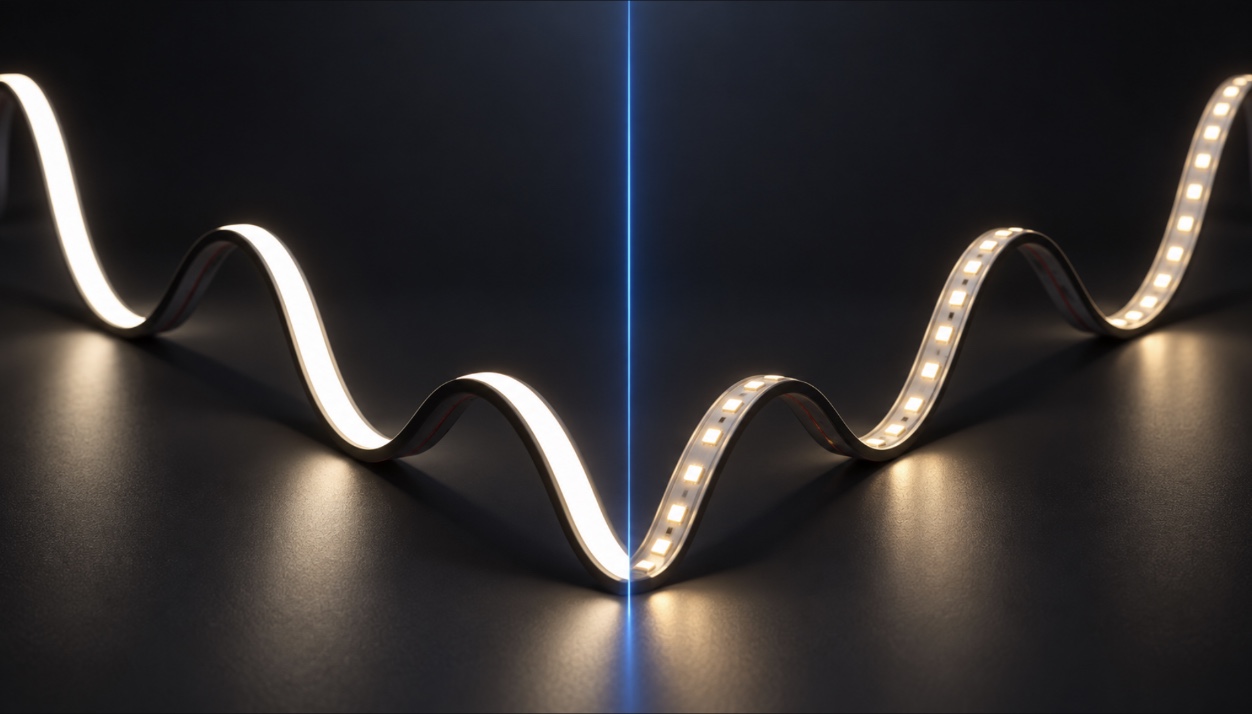
When choosing LED strip lighting, one of the first decisions is whether to use COB or SMD LED strip lights. Both technologies can provide bright, efficient and flexible lighting, but they produce light in different ways and suit different applications.
So, COB vs SMD LED strip — which is better?
The answer depends on your project.
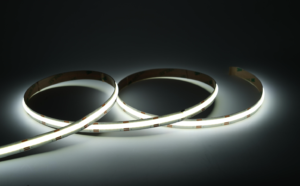
COB LED strip lights are known for their smooth, continuous and dot-free light output. They are a popular choice for applications where the LED strip is visible or installed close to a surface.
SMD LED strip lights use individual LED chips mounted along the strip. They are available in many different configurations, power levels, colour temperatures and designs, making them a flexible option for many residential, commercial and architectural projects.
In this guide, we compare COB vs SMD LED strip lights, including light quality, brightness, energy use, flexibility, installation, applications and cost. We will also explain which type may be suitable for kitchens, cabinets, ceilings, outdoor areas, commercial spaces and decorative lighting.
What Is a COB LED Strip Light?
COB stands for Chip on Board.
In a COB LED strip, many small LED chips are mounted directly onto the circuit board. The chips work together to create a more continuous line of light.
Unlike traditional LED strips where individual LED points can often be seen, COB technology creates a much smoother appearance.
This makes COB LED strip lights especially useful when you want a clean lighting effect without obvious bright and dark spots.
Key features of COB LED strip lights
- Smooth and continuous light
- Reduced visible LED dots
- Wide beam angles on many models
- Excellent option for aluminium profiles
- Suitable for cabinets and joinery
- Ideal for cove and architectural lighting
- Available in warm, neutral and cool white
- Available in RGB and other colour options
- Available in indoor and outdoor-rated versions
- High colour rendering options are available
COB strips are particularly useful when the lighting needs to look like a continuous line rather than a series of individual points.
Explore Vesta Lines LED Strip Lights
What Is an SMD LED Strip Light?
SMD stands for Surface Mounted Device.
SMD LED strips use individual LED chips mounted directly onto the surface of the flexible circuit board.
You may see LED strips described using numbers such as 2835, 3528, 5050 or 5630. These numbers generally refer to the physical size and configuration of the LED package.
SMD LED strips have been widely used for many years and are available in a large range of specifications.
Depending on the product, SMD LED strips can provide different levels of brightness, colour temperatures, LED densities, power consumption and colour options.
Key features of SMD LED strip lights
- Individual LED chips
- Many available LED configurations
- Wide range of brightness options
- Available in different colour temperatures
- Available in single-colour and RGB versions
- Suitable for general and decorative lighting
- Available in different IP protection levels
- Available in different LED densities
- Suitable for residential and commercial applications
SMD technology remains a practical option for many lighting projects, particularly when the strip will be installed inside a profile, behind a diffuser or in a location where individual LED points are not visible.
COB vs SMD LED Strip Lights: Key Differences
The main difference between COB and SMD LED strips is how the LED chips are arranged and how the light appears.
COB strips use many closely positioned LED chips to create a continuous light line.
SMD strips use separate LED packages positioned along the strip.
This difference affects the appearance of the light, especially when the strip is installed close to a visible surface.
COB vs SMD comparison
| Feature | COB LED Strip | SMD LED Strip |
|---|---|---|
| LED technology | Chip on Board | Surface Mounted Device |
| Light appearance | Smooth and continuous | Individual LED points may be visible |
| Dot-free effect | Excellent | Depends on LED density and diffuser |
| LED arrangement | Closely packed chips | Individual LED packages |
| Beam angle | Often wide | Depends on product |
| Aluminium profile | Recommended for many installations | Recommended for many installations |
| Applications | Architectural, cabinets, cove, decorative | General, commercial, decorative and architectural |
| Colour options | White, CCT, RGB and more | White, CCT, RGB and more |
| Outdoor options | Available | Available |
| Flexibility | Highly flexible | Highly flexible |
| Heat management | Profile recommended for many higher-power products | Profile recommended for many higher-power products |
| Best feature | Smooth light appearance | Wide product and configuration choice |
COB vs SMD: Which Has Better Light Quality?
Light quality is one of the biggest reasons people choose COB LED strip lighting.
Traditional SMD strips can create visible points of light when the LED strip is installed close to a surface or when a shallow aluminium profile is used.
COB technology reduces this effect by placing the light-emitting chips much closer together.
The result is a more continuous appearance.
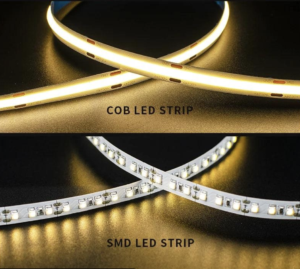
COB LED strip light
COB is a strong option when you want:
- A smooth line of light
- Minimal visible dots
- A premium appearance
- Clean cabinet lighting
- Cove lighting
- Architectural lighting
- Continuous accent lighting
SMD LED strip light
SMD can work very well when:
- The strip is hidden from direct view
- A diffuser is being used
- The installation provides enough distance from the surface
- Individual LED points are not important
- You need a particular LED package or power level
Therefore, if your main priority is smooth, dot-free lighting, COB is often the technology to consider first.
COB vs SMD: Which Is Brighter?
Brightness should not be judged by COB or SMD technology alone.
A common mistake is to assume that every COB strip is brighter than every SMD strip, or that SMD is automatically more powerful.
Actual light output depends on the product specifications.
Important factors include:
- Wattage per metre
- Lumens per metre
- LED density
- LED efficiency
- Voltage
- Colour temperature
- Circuit design
- Heat management
- Installation conditions
For example, a high-output SMD strip can produce more light than a lower-power COB strip.
Likewise, a high-power COB strip can provide strong and even illumination.
What should you compare?
When comparing two LED strips, look at the lumens per metre and wattage per metre, rather than technology alone.
For commercial or task lighting, calculate the total required light output for the area.
For decorative lighting, the appearance and consistency of the light may be more important than maximum brightness.
COB vs SMD: Which Is More Energy Efficient?
Both COB and SMD LED strip lights can be energy efficient.
However, energy efficiency should be compared using the actual product specifications rather than simply choosing COB or SMD.
Look at:
- Watts per metre
- Lumens per metre
- Lumens per watt
- Total length
- Required brightness
- Operating hours
For example, if one strip uses 10W per metre and another uses 15W per metre, the 15W strip will normally consume more electricity when both are operated for the same amount of time.
However, the higher-power strip may also produce substantially more light.
The important comparison is therefore light output versus power consumption.
COB vs SMD: Which Has Better Flexibility?
Both COB and SMD LED strips are flexible and can be used around many shapes and surfaces.
They can be installed for:
- Curved cabinetry
- Shelving
- Benches
- Wall features
- Ceiling details
- Cove lighting
- Display cabinets
- Joinery
- Furniture
- Commercial displays
However, the physical dimensions and bend radius can vary between products.
Always check the manufacturer’s specifications before installing an LED strip around tight corners.
COB vs SMD for Aluminium Profiles
Aluminium profiles are commonly used with LED strip lighting.
They provide several benefits, including:
- Cleaner installation
- Physical protection
- Better heat management
- Straighter installation
- Professional appearance
- Diffuser compatibility
- Reduced visibility of individual LED points
A diffuser can also help create a softer appearance.
COB with aluminium profile
COB LED strips already provide a smooth light effect, so they can work particularly well with aluminium profiles and diffusers.
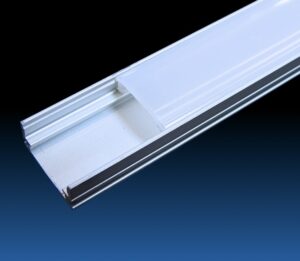
This combination is useful for:
- Kitchens
- Wardrobes
- Shelving
- Wall lighting
- Ceiling details
- Commercial interiors
SMD with aluminium profile
SMD strips can also work very well in aluminium profiles.
A diffuser can reduce the visibility of individual LED points, particularly when the strip has a suitable LED density and the profile provides enough distance between the LEDs and diffuser.
View Vesta Lines Aluminium Extrusion Profiles
COB vs SMD for Kitchen Lighting
Kitchen lighting is one of the most common applications for LED strip lights.
LED strips can be installed under:
- Kitchen cabinets
- Wall cabinets
- Shelves
- Benchtops
- Breakfast bars
- Display cabinets
- Kickboards
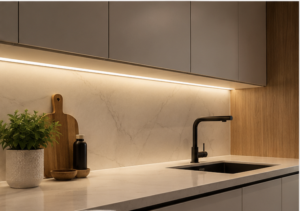
For under-cabinet lighting, COB can be useful because the light can appear as a continuous line rather than individual points.
This creates a clean and modern appearance.
SMD can also be suitable, particularly when the strip is hidden or installed with an aluminium profile and diffuser.

What colour temperature should you choose?
For residential kitchens, 3000K provides warm and comfortable lighting.
4000K produces a more neutral appearance and can be useful where brighter task lighting is required.
The best choice depends on the style of the kitchen and the purpose of the lighting.
COB vs SMD for Ceiling and Cove Lighting
Cove lighting is another application where the appearance of the LED strip is important.
The strip is usually hidden inside a recess, with light directed onto a ceiling or wall.
COB can provide a smooth line of light that works well for this type of installation.
SMD can also be used successfully when the strip is positioned far enough away from the visible surface or when a diffuser is used.
For a clean architectural appearance, consider:
COB strip + aluminium profile + suitable diffuser
This combination can help create a continuous lighting effect.
COB vs SMD for Cabinets and Joinery
Cabinet and joinery lighting often requires a neat and discreet installation.
COB LED strips are particularly useful when the strip is close to the front edge of a cabinet or shelf because the light can appear more uniform.
Common applications include:
- Wardrobes
- Display cabinets
- Kitchen cabinets
- Bookshelves
- Bathroom cabinetry
- Retail displays
- Office storage
For joinery projects, the physical size of the strip is also important.
Always check the strip width and available profile before ordering.
COB vs SMD for Commercial Lighting
Both technologies can be used for commercial applications.
Examples include:
- Retail stores
- Restaurants
- Cafes
- Hotels
- Offices
- Showrooms
- Display cabinets
- Signage
- Architectural features
COB can be useful where a premium continuous lighting effect is required.
SMD can be useful when a particular power level, LED configuration or lighting specification is required.
The choice should be based on the project’s required light output, appearance, installation conditions and control requirements.
COB vs SMD for Outdoor Lighting
Outdoor installations require additional consideration.
Rain, humidity, direct sunlight, temperature changes and water exposure can affect LED strip lighting and its electrical connections.
The LED strip must have an appropriate IP rating for the installation environment.
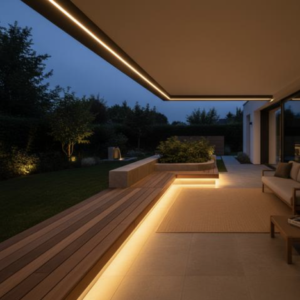
Common IP ratings
| IP Rating | General Application |
|---|---|
| IP20 | Dry indoor areas |
| IP44 | Areas with limited splash exposure |
| IP65 | Dust protection and water jets |
| IP67 | Greater water protection and temporary immersion under specified conditions |
| IP68 | Continuous immersion under manufacturer-defined conditions |
An IP rating applies to the product as tested. The complete installation also depends on connectors, cable entries, joins, end caps and the power supply.
For outdoor projects, do not assume that an indoor LED strip becomes waterproof simply because it is installed inside an aluminium profile.
View Vesta Lines IP65 COB LED Strip Lights
View Vesta Lines IP67 COB LED Strip Lights
COB vs SMD: What About Waterproof LED Strips?
If your project is outdoors, around water or exposed to weather, choose the IP rating based on the actual installation environment.
For example:
Covered patio
A covered patio with limited direct rain exposure may require less protection than a fully exposed installation.
Exposed outdoor area
An exposed pergola, garden feature or outdoor wall may need a higher level of water protection.
Wet locations
Areas exposed to significant water require careful selection of the strip, connectors and power supply.
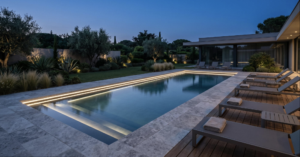
Underwater applications
For underwater applications, use a product specifically designed and approved for continuous immersion under the manufacturer’s stated conditions.
An IP68 rating alone does not automatically mean a product is suitable for swimming pools.
For pool installations, check requirements such as:
- Approved installation depth
- Maximum immersion time
- Water temperature
- Chlorinated water compatibility
- Saltwater compatibility
- Cable and termination requirements
- Driver or transformer requirements
- Applicable Australian electrical requirements
Always use a suitably qualified electrical professional for installations where electrical safety requirements apply.
COB vs SMD: Colour Temperature Options
Both COB and SMD LED strips are available in different colour temperatures.
2700K
Very warm white.
Suitable for:
- Relaxed spaces
- Hospitality areas
- Decorative lighting
- Timber features
- Bedrooms
3000K
Warm white.
A popular choice for:
- Homes
- Kitchens
- Living areas
- Bedrooms
- Outdoor entertaining areas
4000K
Neutral white.
Useful for:
- Kitchens
- Work areas
- Offices
- Retail spaces
- Commercial applications
6000K–6500K
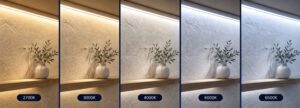
Cool white.
Often used where a brighter, cooler appearance is required.
The ideal colour temperature depends on the environment and the desired appearance.
COB vs SMD for RGB and Colour-Changing Lighting
COB and SMD LED strips can both be available in colour-changing versions.
RGB LED strips can produce multiple colours using red, green and blue LED channels.
Some products also provide white-light options through RGBW or RGB+CCT technology.
These systems require compatible controllers and power supplies.
For example, a smart lighting system may allow users to:
- Turn the strip on and off
- Dim the light
- Change colours
- Adjust white colour temperature
- Create scenes
- Control multiple lighting sections
When selecting an RGB or smart LED strip, make sure the strip, controller and power supply are compatible.
Explore Vesta Lines RGB COB LED Strip Lights
COB vs SMD: Voltage and Longer Runs
LED strip lights are commonly available in 12V or 24V systems.
For many installations, 24V LED strips can be useful for longer runs because the same power requires less current compared with a 12V system.
However, the maximum recommended run depends on the specific LED strip.
Voltage drop can cause the LEDs at the end of a long run to appear dimmer or change colour.
Ways to manage voltage drop include:
- Keeping individual runs within the manufacturer’s recommended maximum
- Using power injection where appropriate
- Feeding longer runs from suitable points
- Using correctly sized cable
- Choosing an appropriate voltage system
- Planning the power supply location carefully
Do not assume that every 24V LED strip can run any length from one end.
Always check the manufacturer’s specifications.
COB vs SMD: Heat Management
LED strips produce heat while operating.
Heat management becomes increasingly important as power consumption increases.
For many LED strip installations, an aluminium profile can help transfer heat away from the strip and provide a cleaner installation.
This is especially important for higher-power strips.
A profile can also protect the strip from physical damage and provide a location for a diffuser.
However, an aluminium profile does not automatically make an LED strip waterproof.
The strip’s IP rating and the installation method still need to be suitable for the environment.
COB vs SMD: Installation Considerations
Before installing an LED strip, consider more than just the type of LED technology.
Check the following:
1. Strip width
Make sure the strip fits inside the selected aluminium profile.
2. Wattage
Calculate the total power required for the complete length.
For example:
10W/m × 10m = 100W
The power supply should be selected based on the manufacturer’s requirements and suitable design margin.
3. Voltage
Confirm whether the strip requires 12V DC or 24V DC.
4. Maximum run
Check the recommended maximum continuous run.
5. IP rating
Choose the appropriate IP protection for the environment.
6. Connections
Use suitable connectors, cable and termination methods.
7. Heat management
Higher-power strips may require an aluminium profile for heat dissipation.
8. Controller compatibility
For dimming, RGB, CCT or smart lighting, make sure the controller matches the strip.
Common Mistakes When Choosing COB or SMD LED Strip Lights
Choosing the LED technology is only one part of the project.
Here are some common mistakes to avoid.
Mistake 1: Choosing based only on wattage
Higher wattage does not automatically mean better lighting.
Compare wattage with actual light output and the requirements of the space.
Mistake 2: Ignoring LED density
A low-density SMD strip may show more visible points than a high-density strip.
If you need smooth lighting, compare LED density and consider COB technology.
Mistake 3: Using indoor strip lights outdoors
Indoor LED strips should not be used in exposed outdoor areas unless the product is specifically suitable for the environment.
Mistake 4: Using unsuitable connectors
The strip may have a suitable IP rating, but an unprotected connection can become a weak point.
Use connectors and termination methods appropriate for the installation.
View Vesta Lines LED Strip Connectors
Mistake 5: Ignoring voltage drop
Long LED strip runs can experience voltage drop.
Plan cable sizes, feed points and maximum run lengths before installation.
Mistake 6: Selecting the wrong power supply
The power supply must match the strip voltage and total power requirements.
Mistake 7: Forgetting heat management
Higher-power LED strips can require suitable heat dissipation.
Mistake 8: Choosing the wrong colour temperature
A colour temperature that looks good in one room may not suit another.
Consider the existing lighting, surfaces and purpose of the space.
COB vs SMD LED Strip Lights: Which Should You Choose?
Instead of asking which technology is universally better, start with the lighting result you want.
Choose COB when you want:
- Smooth continuous light
- Minimal visible LED dots
- Clean architectural lighting
- Cabinet and joinery lighting
- Premium decorative lighting
- Cove lighting
- Close-to-surface installation
Consider SMD when you want:
- A wide range of LED configurations
- Different power options
- Specific LED package types
- General-purpose lighting
- Decorative lighting
- Commercial applications
- A strip that will be concealed or diffused
The installation environment is also important.
For outdoor applications, choose the appropriate IP-rated version regardless of whether the strip is COB or SMD.
COB vs SMD LED Strip Lights: Which Is Better?
`COB vs SMD: Quick Decision Guide
| Your Requirement | Option to Consider |
|---|---|
| Smooth, continuous light | COB |
| Minimal visible LED dots | COB |
| Cabinet lighting | COB or high-density SMD |
| Cove lighting | COB or suitable SMD |
| General decorative lighting | COB or SMD |
| Wide range of configurations | SMD |
| RGB lighting | COB or SMD |
| Outdoor lighting | Suitable IP-rated COB or SMD |
| Wet environment | Appropriate IP-rated product |
| Underwater application | Specifically approved immersion product |
| High-power installation | Check wattage, heat management and profile requirements |
| Smart lighting | Compatible strip + controller + power supply |
Final Thoughts: COB vs SMD LED Strip
COB and SMD LED strip lights can both provide effective and flexible lighting solutions.
The key difference is the way the LEDs are arranged and how the finished light appears.
COB LED strips are particularly useful when you want smooth, continuous and low-dot illumination.
SMD LED strips provide a broad range of configurations and remain suitable for many residential, commercial and decorative lighting applications.
For the best result, look beyond the COB vs SMD label. Compare the complete product specifications, including lumens, wattage, LED density, colour temperature, CRI, voltage, IP rating and maximum run length.
Then consider the installation itself, including the aluminium profile, diffuser, connectors, power supply and controller.
By choosing the right combination of LED strip and accessories, you can create clean, efficient and practical lighting for kitchens, cabinets, ceilings, retail spaces, outdoor areas and architectural projects.