The Advantages of COB LED Lighting: Why Choose COB LED Lights?
Discover the Benefits of COB LED Technology for Residential, Commercial and Architectural Lighting
Choosing the right lighting technology is essential for creating comfortable, efficient and visually appealing spaces. Whether you’re designing lighting for a modern home, retail store, hotel, restaurant, office or commercial project, the quality of the light source can significantly influence the final result.
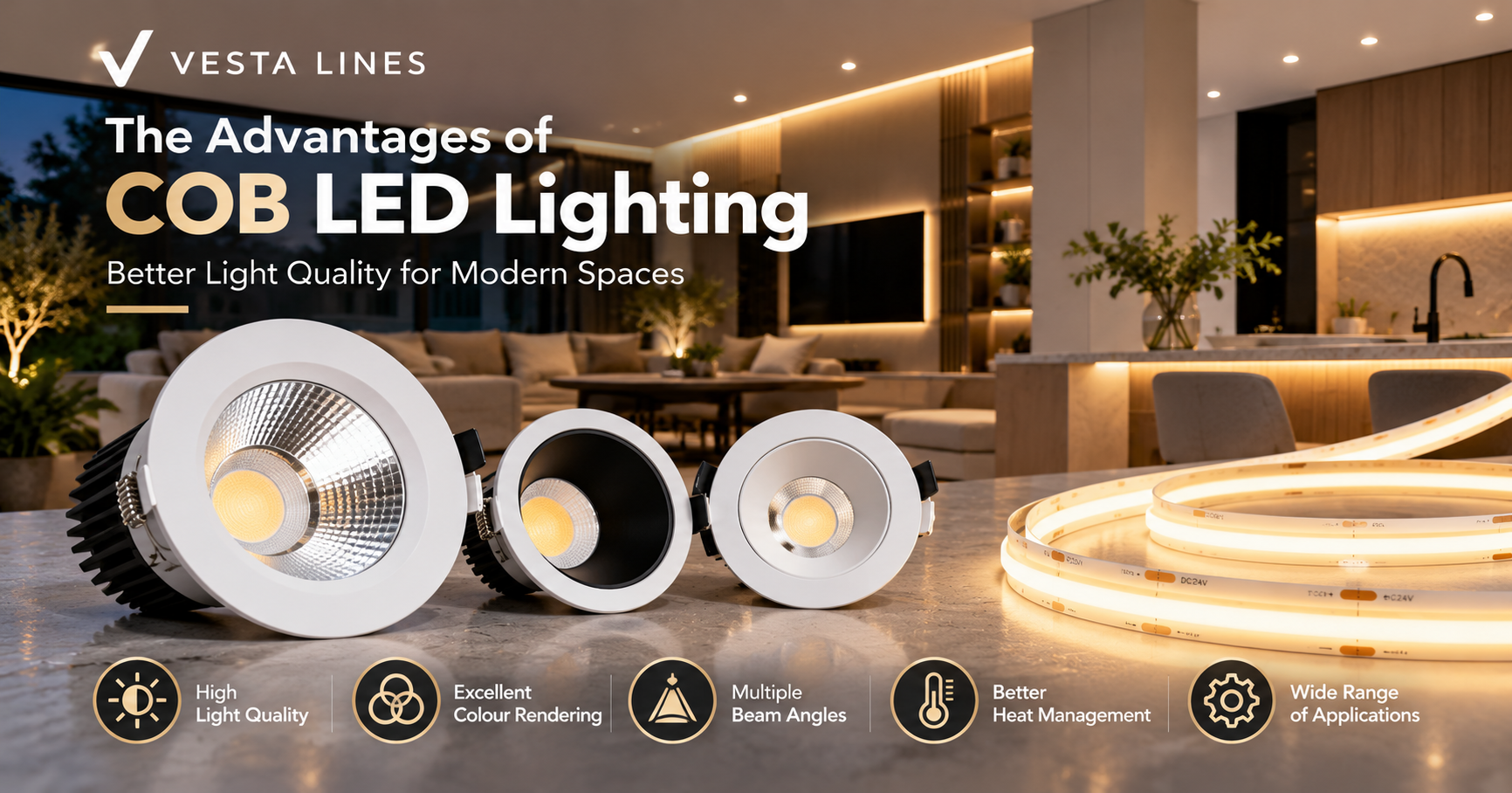
COB LED lighting (Chip on Board) is a popular lighting technology used in modern downlights, spotlights, architectural luminaires and LED strip lighting.
COB technology integrates multiple LED chips closely together on a common substrate, creating a concentrated light-emitting surface. Depending on the luminaire design, this can provide excellent light uniformity, efficient optical control and a compact lighting solution.
At Vesta Lines, we understand the importance of selecting the right LED lighting solution for each application. From COB LED downlights to continuous COB LED strip lighting, choosing the correct colour temperature, CRI, beam angle and thermal design is essential for achieving professional lighting results.
1. What Is COB LED Technology?
COB stands for Chip on Board, an LED packaging technology where multiple LED chips are mounted closely together on a single substrate.
Unlike conventional LED arrangements that use separate packaged LED components, COB technology creates a more concentrated light-emitting area.
This design offers several advantages depending on the application:
- Compact and efficient light-source design
- Uniform light emission
- Effective compatibility with reflectors and optical systems
- Excellent potential for architectural lighting
- Smooth, continuous illumination in COB LED strips
- Versatility across residential and commercial applications
COB technology is commonly used in LED downlights, track lights, spotlights, display lighting and linear LED lighting systems.
2. Choosing the Right Colour Temperature (CCT)
Colour temperature is one of the most important considerations when selecting COB LED lighting.
Measured in Kelvin (K), correlated colour temperature (CCT) describes whether white light appears warm, neutral or cool.
2700K – Warm White
Produces a soft, warm atmosphere suitable for:
- Bedrooms and living rooms
- Hotels and hospitality environments
- Restaurants and lounges
- Decorative architectural lighting
3000K – Warm White
A popular choice for comfortable, sophisticated lighting in:
- Residential interiors
- Hotels
- Retail boutiques
- Restaurants
- Architectural downlighting
4000K – Neutral White
Provides a balanced, clear appearance suitable for:
- Offices
- Commercial interiors
- Kitchens
- Retail stores
- Showrooms
- General task lighting
5000K – Cool/Daylight White
Offers a cooler, daylight-like appearance often considered for:
- Selected industrial environments
- Workshops
- Warehouses
- Technical work areas
Vesta Lines lighting recommendation: For many premium residential and hospitality projects, 3000K is an excellent starting point. For commercial workspaces and task-oriented environments, 4000K may be more suitable.
The final selection should always consider the space, materials, lighting design and user requirements.
3. Why CRI Matters in COB LED Lighting
The Colour Rendering Index (CRI) describes how accurately a light source renders colours compared with a reference illuminant.
CRI is especially important in applications where colours, finishes, merchandise and interior materials need to appear natural.
CRI 80+
Generally suitable for many everyday residential and commercial lighting applications.
CRI 90+
Often preferred for applications where colour appearance is particularly important, including:
- Retail displays
- Fashion stores
- Art galleries
- Hotels
- Premium residential interiors
- Architectural feature lighting
- Showrooms
A higher CRI can help reveal subtle differences in materials, textures and colours.
For example, Vesta Lines’ 12W COB LED Dimmable Downlight Deep Cone White features a CRI of 90, making it suitable for applications requiring good colour rendering and controlled illumination.
4. COB LED Lighting and Beam Angle
The beam angle determines how widely light spreads from a luminaire.
Selecting the correct beam angle is essential for achieving the intended lighting effect.
Narrow Beam: Approximately 10°–25°
Narrow beam angles are useful for focused accent lighting, including:
- Artwork
- Sculptures
- Retail displays
- Architectural features
- Feature walls
Medium Beam: Approximately 25°–45°
Medium beam angles are commonly used for:
- Retail lighting
- Hospitality environments
- Display areas
- Residential accent lighting
- General downlighting with controlled distribution
Wide Beam: Approximately 45°–60° or Greater
Wider beam angles can be useful for:
- General room lighting
- Commercial spaces
- Residential downlighting
- Corridors
- Areas requiring broader light distribution
The ideal beam angle depends on mounting height, spacing, target illumination and the size of the area being lit.
A smaller COB light-emitting surface can help optical designers achieve tighter beams with suitable lenses or reflectors. However, the final beam angle depends on the complete optical design, not simply the COB chip size.
5. COB LED Lighting for Architectural Applications
COB LED technology is especially useful in architectural lighting because it can combine compact light sources with carefully controlled illumination.
Architects, lighting designers and electrical contractors can use COB lighting to create a range of visual effects.
Residential Lighting
COB LED downlights can provide focused illumination for kitchens, living rooms, hallways and feature areas.
Retail and Fashion Lighting
Good colour rendering and controlled beam distribution help highlight merchandise, clothing, materials and displays.
Hotel and Hospitality Lighting
COB lighting can support warm, comfortable environments with discreet fixtures and controlled glare.
Restaurants and Cafés
Warm colour temperatures and carefully positioned lighting can create an inviting atmosphere.
Commercial and Office Lighting
COB luminaires can provide controlled illumination for selected task areas, circulation spaces and architectural features.
Galleries and Showrooms
High-CRI COB lighting can help present products, artworks and finishes with accurate colour appearance.
6. The Advantages of COB LED Strip Lighting
COB technology is not limited to downlights and spotlights.
COB LED strip lights have become increasingly popular for modern architectural and decorative lighting.
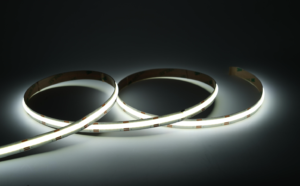
Unlike many conventional LED strips where individual light points may be visible, COB LED strips use a dense arrangement of light-emitting chips beneath a continuous phosphor layer.
This creates a smoother, more uniform line of light.
Benefits of COB LED Strip Lights
Continuous lighting appearance
COB strips can produce a smooth line of illumination with reduced visible spotting.
Architectural integration
They are well suited to recessed profiles, cabinetry, joinery and decorative lighting details.
Flexible installation options
Depending on the product, COB LED strips can be installed in suitable straight or curved configurations.
Excellent for aluminium profiles
COB strips can be combined with compatible aluminium profiles and diffusers to create clean linear lighting installations.
Decorative and functional applications
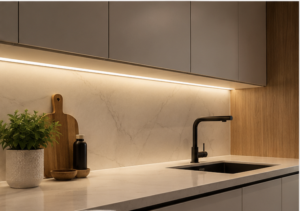
They can be used for under-cabinet lighting, shelving, coves, display cabinets, feature walls and commercial interiors.
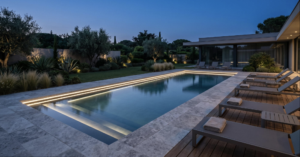
For outdoor applications, select a COB strip and complete installation system with an appropriate IP rating.
7. Heat Dissipation and COB LED Performance
Heat management is one of the most important factors affecting LED lighting performance and reliability.
Although LEDs are energy-efficient, they still generate heat during operation.
If this heat is not managed correctly, it can affect:
- Light output
- Colour stability
- LED efficiency
- Component reliability
- Long-term performance
Why Heat Sink Design Matters
A properly designed luminaire uses suitable thermal materials and heat-dissipation structures to transfer heat away from the LED source.
The thermal design should consider the COB module, operating current, luminaire housing, ambient temperature and installation conditions.
For COB LED downlights, the heat sink and luminaire body play an important role in thermal management.
For COB LED strip lighting, compatible aluminium profiles can help transfer heat away from the strip.
Important: A higher-wattage COB light source is not automatically better. The complete luminaire must be designed to manage the electrical and thermal load.
8. COB LED Quality and Optical Compatibility
The quality of a COB LED luminaire depends on more than the LED chip itself.
A professional lighting product combines several components that must work together effectively:
- COB LED module
- Optical reflector or lens
- Thermal management system
- LED driver
- Luminaire housing
- Control and dimming system
Optical Matching
The COB light source must be matched with the appropriate optical components.
Poor optical matching can result in uneven illumination, unwanted glare or an unsuitable beam distribution.
A well-designed reflector or lens helps direct light where it is needed.
Colour Consistency
Colour consistency is especially important when multiple luminaires are installed within the same space.
Consistent colour appearance helps create a more professional result in retail, hospitality and architectural projects.
Driver Compatibility
The LED driver must match the electrical requirements of the COB module.
For dimmable applications, the driver and dimming system must also be compatible.
9. COB LED Downlights vs Traditional LED Downlights
COB LED downlights and downlights using other LED packaging technologies can both provide excellent performance.
However, COB downlights are particularly useful where a concentrated light source and controlled beam are desired.
| Feature | COB LED Downlights | Other LED Downlight Designs |
|---|---|---|
| Light source | Concentrated COB module | Individual LED packages or arrays |
| Beam control | Well suited to reflector and lens optics | Depends on optical design |
| Accent lighting | Excellent potential | Depends on luminaire |
| Colour rendering | Depends on LED specification | Depends on LED specification |
| Glare control | Depends on recess and optical design | Depends on recess and optical design |
| General lighting | Suitable with appropriate beam | Suitable with appropriate beam |
The best choice depends on the lighting design rather than the LED packaging technology alone.
10. How to Choose the Right COB LED Light
Before selecting a COB LED luminaire, consider the following factors.
Application: Is the lighting intended for residential, retail, hospitality, commercial or architectural use?
Colour temperature: Choose the appropriate CCT for the space and desired atmosphere.
Colour rendering: Select a suitable CRI, particularly where accurate colour appearance is important.
Beam angle: Match the beam distribution to the mounting height and target area.
Light output: Choose the required lumens based on the lighting design rather than wattage alone.
Glare control: Consider recessed designs, reflectors and appropriate fixture placement.
Thermal performance: Ensure the luminaire is designed for the operating conditions.
Dimming: Confirm compatibility with the required dimming system.
Installation: Check the dimensions, cut-out size, driver requirements and environmental rating.
11. Why Choose Vesta Lines COB LED Lighting?
Vesta Lines supplies LED lighting products for residential, commercial and architectural applications across Australia.
Our lighting range includes solutions for different installation requirements, including:
- COB LED downlights
- Anti-glare LED downlights
- Dimmable LED lighting
- COB LED strip lights
- Architectural linear lighting
- LED aluminium profiles
- LED drivers and power supplies
- LED strip connectors and accessories
Whether you’re designing a modern home, fitting out a retail store or planning a commercial lighting project, selecting the correct combination of lighting technology, optics, colour temperature and control equipment can help achieve the desired result.
Frequently Asked Questions About COB LED Lighting
What does COB mean in LED lighting?
COB stands for Chip on Board. It is a technology in which multiple LED chips are mounted closely together on a common substrate to create a concentrated light-emitting area.
Are COB LED lights better than standard LED lights?
COB LEDs offer advantages for certain applications, particularly compact light sources, controlled beam lighting and smooth LED strip illumination. However, overall performance depends on the complete product design and quality.
Are COB LED lights suitable for commercial lighting?
Yes. COB technology is widely used in commercial downlights, track lighting, retail displays, hospitality lighting and architectural applications.
What is the best colour temperature for COB LED lighting?
3000K is popular for warm residential and hospitality lighting, while 4000K is often suitable for commercial and task-oriented environments. The ideal choice depends on the application.
Is CRI 90 important for COB LED lights?
CRI 90 can be beneficial where accurate colour rendering is important, such as fashion retail, galleries, showrooms and premium residential interiors.
Do COB LED lights need heat sinks?
COB LED luminaires require suitable thermal management. The heat sink or thermal structure must be designed to manage heat under the intended operating conditions.
What is the difference between COB LED downlights and COB LED strips?
COB downlights use concentrated light sources with optics to provide controlled illumination. COB LED strips use closely spaced chips to produce a continuous linear lighting appearance.
Can COB LED strip lights be used outdoors?
Yes, if the specific product and complete installation are appropriately rated for outdoor conditions. Check the IP rating and manufacturer specifications before installation.
Explore COB LED Lighting at Vesta Lines
Choosing the right COB LED lighting involves balancing light quality, colour temperature, beam control, energy efficiency and thermal performance.
From precision downlights to continuous architectural COB LED strips, Vesta Lines offers lighting solutions for a wide range of residential and commercial projects.
Discover COB LED lighting solutions at Vesta Lines and explore products designed for modern lighting applications across Australia.